



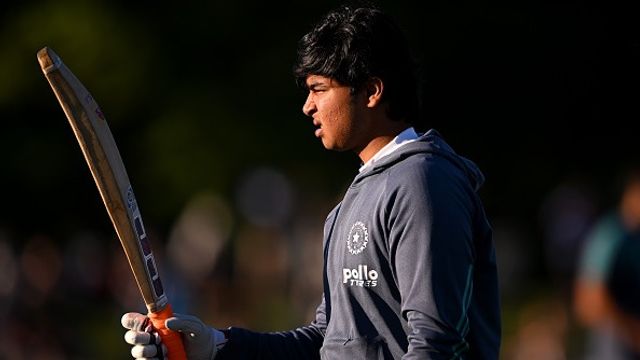
India's batting prodigy Vaibhav Sooryavanshi did get a chance to feature in India's playing XI in the second T20I against New Zealand, but could make the best use of the opportunity given.
Despite carrying sky-high expectations, Sooryavanshi has struggled to replicate his jaw-dropping IPL dominance in India's national colors. The rise of teen phenom Vaibhav Sooryavanshi has been nothing short of a cinematic marvel. Bursting onto the big stage as a prodigy for Rajasthan Royals, the youngster redefined powerplay batting during IPL 2026, amassing an astonishing 776 runs in 16 matches to claim the Orange Cap at a breathtaking strike rate of 237.30. Yet, as the teenage prodigy makes his initial strides in international cricket, he finds himself grappling with a harsh reality check.
His transition from franchise sensation to international star has hit an early speedbump, marked by prolonged bench time, tactical missteps, and awkward positional adjustments.
Vaibhav Sooryavanshi's Flop show against New Zealand in Christchurch
Sooryavanshi’s recent outing in the second T20I against New Zealand at Christchurch was a prime illustration of his ongoing international teething troubles. Drafted into the playing XI after a long hiatus following an adductor injury to first-choice wicketkeeper-batter Ishan Kishan, the 15-year-old was handed a golden opportunity to prove his mettle against a quality SENA (South Africa, England, New Zealand, Australia) opponent.
Instead, the outing turned into a major flop show. Walking in at No. 3, Sooryavanshi looked uncharacteristically tentative on a pitch that offered subtle bounce and seam movement. Facing 8 balls, the youngster managed just 4 runs without a single boundary before perishing early in his innings.
Rather than seizing the moment to anchor or accelerate, his brief stay exposed a total lack of rhythm, leaving India in an early spot of bother before the lower-middle order staged a recovery.
Real reasons behind Sooryavanshi's struggles on big stage
The glaring gap between Sooryavanshi’s IPL dominance and his international stutter boils down to a few fundamental factors:
Firstly, Sooryavanshi is an instinctive, natural opener who relies heavily on utilizing the field restrictions during the powerplay overs. Being forced to bat lower down the order—or coming in after early wickets—robs him of his primary strength. i.e. taking down fielders in the 30-yard circle from ball one.
Secondly, while IPL bowlers often deal with back-to-back matches and varying squad depth, international bowling attacks deploy sharp, targeted analysis. Top-tier international seamers have exploited Sooryavanshi's high-wrist O grip and double-downswing trigger movement by crowding him with back-of-a-length deliveries into his ribs and angling balls across him.
Thirdly, high-velocity IPL seasons provide players with 14 to 17 guaranteed games in rapid succession, allowing batters to maintain touch and bounce back quickly from failures. In international cricket, sporadic appearances destroy a young batter's underlying confidence.
Fourthly, despite earning regular inclusions in India's main squad across multiple series, Sooryavanshi has spent the vast majority of his time on the bench as a spectator. The competitive depth of the Indian top order has kept him on the sidelines, forcing him to warm the bench while established players take precedence.
Match-by-Match Breakdown of Featured vs. Missed Matches:
| Series / Tournament | Matches Played | Matches Benched / Missed | Performances in Featured Matches |
| Tour of England (T20Is) | 1 Match | 4 Matches | 14 (10) vs England |
| Tour of Zimbabwe (T20Is) | 3 Matches | 2 Matches | 50 (19), 20 (9), 81 (49) |
| Asian Games 2026 | 2 Matches | 1 Match | 38 (21) vs Sri Lanka, 15 (9) vs Pakistan |
| Tour of New Zealand (T20Is) | 1 Match (2nd T20I) | 1 Match (1st T20I) | 4 (8) vs New Zealand |
While his figures against Zimbabwe proved his explosive potential (including 151 runs across three matches), his performances against top-tier opposition like England and New Zealand highlight his vulnerability when thrust into the lineup without regular game time.
The contrast between Sooryavanshi’s IPL numbers and his international T20 record reveals two completely different narratives.
IPL Heroics vs. International Reality
| Category | IPL 2026 | T20 Internationals |
| Matches Played | 16 | 9 |
| Total Runs | 776 | 250 |
| Batting Average | 51.73 | 27.77 |
| Strike Rate | 237.30 | 178.57 |
| Key Milestones | 1 Orange Cap | Ye to |
In the IPL, Sooryavanshi operated with absolute freedom for Rajasthan Royals. Batting on flat, boundary-friendly home tracks with clear tactical clarity as an opener, he dismantled international and domestic pacers alike with total authority.However, in T20 Internationals, the combination of unfamiliar overseas surfaces, changing roles, and high-pressure scenarios has reduced his impact. Instead of dictating play, he has frequently been forced into reactive batting.
How the Gamble to Play Him at No. 3 Backfired in Christchurch
When Ishan Kishan was ruled out of the second T20I against New Zealand, the Indian team management faced a dilemma. Rather than disturbing the settled opening pair, captain Shreyas Iyer opted to keep the opening slot intact and deploy Sooryavanshi at No. 3.The gamble backfired. Stripped of his preferred opening slot, Sooryavanshi appeared out of depth coming into the crease during the second over.
The New Zealand seamers immediately adjusted their lengths, denying him width and bowling tight, cramped lines into his pads. Unable to break free during the powerplay, Sooryavanshi played out multiple dot balls before holing out in frustration for a dismal 4 off 8 deliveries.
How Did He Perform at No. 3 in the Asian Games?
The decision to push Sooryavanshi into the top-three middle order was not entirely unprecedented, but history showed it was an unviable solution. During the 2026 Asian Games, the management similarly tinkered with his position.When pushed down from his natural opening role, Sooryavanshi’s output dipped noticeably. While he managed a quickfire 38 off 21 balls against Sri Lanka when promoted at the top, his numbers plummeted whenever he was tasked with entering at one-down or two-down. His struggle to navigate the spin-heavy middle overs without powerplay field restrictions was exposed during the crucial clash against Pakistan, where he managed just 15 off 9 balls. The Asian Games experiment proved that Sooryavanshi is an instinct-driven powerplay enforcer, not an adaptability candidate for the No. 3 spot.
How Sanju Samson and Abhishek Sharma have blocked his path?
The biggest obstacle preventing Sooryavanshi from establishing himself in India's T20I setup is the sheer quality and stability of India's current opening duo: Sanju Samson and Abhishek Sharma. Abhishek Sharma's Powerplay Monopoly: As an explosive left-handed opener, Abhishek plays the exact role that Sooryavanshi excels at. With Sharma consistently laying rapid platforms at the top, India does not need another left-handed powerplay aggressor.
Samson provides senior stability and elite ball-striking upfront, making it virtually impossible for team management to drop him to accommodate a teenage prodigy. With both opening slots firmly locked, Sooryavanshi remains trapped in a tactical dilemma. He is too talent-rich to be left out of squad selections entirely, yet unable to claim his preferred position on the field. Until India finds a way to either transition him effectively into a flexible middle-order role or grant him an extended run at the top, Sooryavanshi could continue to suffer a frightening fate which might take away his confidence. But looking at the fickle nature of T20Is, getting a concrete sample size is complicated due to these reasons.
Notably, Ishan has been ruled out of the third match as well which means Sooryavanshi will have another go to prove his might in Wellington on October 27.