


 Home


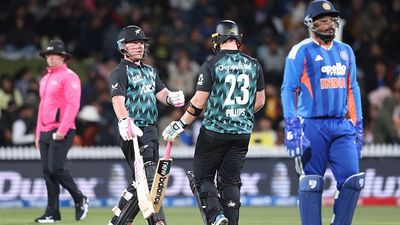
India did win the series 3-2 but couldn't finish well in the just-concluded T20I series against New Zealand as they suffered a crushing seven-wicket hammering in the fifth match in Hamilton on November 1. The fifth T20I at Seddon Park served up a sobering reminder of the team's underlying bowling vulnerabilities, which have been on display for quite a time now.
ADVERTISEMENT
Asked to bat first on a pristine Hamilton pitch, India posted a competitive 191/8 powered by fluent half-centuries from Ishan Kishan (61 off 32) and captain Shreyas Iyer (50 off 23). Yet, a deflated Indian bowling attack failed to defend the 192-run target, as New Zealand overhauled the target with 12 balls to spare, courtesy of a masterclass from Tim Seifert (93 off 50) and Glenn Phillips (65 off 38).
Milne’s stranglehold and India’s mid-innings stutter
India's innings got off to a jittery start, losing early wickets before Ishan Kishan and Shreyas Iyer stabilised and accelerated the tempo with a brilliant 107-run partnership. Kishan slammed 61 off 32 deliveries (featuring 5 fours and 5 sixes), while Iyer hammered a 23-ball 50 (including 4 sixes and 3 fours).
However, once New Zealand broke that partnership, the Indian innings fell away dramatically. Stepping up with lethal precision, Adam Milne delivered a brilliant spell of 4/19 in his 4 overs. Milne’s fiery pace and clever variations dismantled the lower-middle order, as he clinically dismissed Sanju Samson (4 off 10), Abhishek Sharma (1 off 2), Nitish Kumar Reddy (22 off 17) and Bhuvneshwar Kumar (6 off 4).
Milne’s disciplined execution, backed by Nathan Smith's 2/28, restricted India to 191/8, preventing what looked like a certain total past the 200-run mark.
Tim Seifert, Glenn Phillips' blazing fifties in NZ's chase
Defending 192 required early breakthroughs and tight lines, but India got neither. Although Arshdeep Singh removed Finn Allen early, Tim Seifert and Glenn Phillips took complete control. Tim Seifert played a sensational knock of 93 off just 50 balls, cracking 11 fours and 5 sixes at a strike rate of 186. He anchored the chase before falling agonizingly short of a century, clean-bowled by Nitish Kumar Reddy. Complementing him brilliantly was Glenn Phillips, who smashed an unbeaten 65 off 38 balls (hitting 8 fours and 3 sixes). Together, Seifert and Phillips mixed brute force with calculated pacing, neutralising the Indian spinners and rendering the pace attack toothless as the Black Caps cruised to 195/3 in 18 overs.
India’s Deflated Bowling and Bleeding Economy Rates
India's bowling attack lacked teeth, precision, and penetration throughout the defense. Hampered perhaps by lack of plans against aggressive stroke-play, the bowlers leaked runs at an alarming frequency. A glaring indicator of the bowling unit's struggles was that the minimum economy rate recorded by any Indian bowler in the match was a steep 9.50 (achieved by Nitish Kumar Reddy, who gave up 19 runs in 2 overs, and Arshdeep Singh, who conceded 40 in his 4). Varun Chakaravarthy conceded 45 in 4 overs (economy 11.25), Prince Yadav leaked 35 in 3 overs (economy 11.67), and Abhishek Sharma went for 13 in his lone over (economy 13.00) and the comeback man Bhuvneshwar Kumar conceded 41 in his four overs. The inability to stem the flow of boundaries or pick up mid-overs wickets exposed a fragile underbelly in India's bowling depth.
Bhuvneshwar Kumar’s Torrid Tour
The series proved to be a nightmare comeback tour for veteran swing bowler Bhuvneshwar Kumar, who looked entirely ineffective across the five matches. Tasked with leading the attack and utilising the new ball, Bhuvneshwar lacked his trademark zip and movement, turning into an easy target for New Zealand's aggressive openers. His series statistics underline a torrid outing:
1st T20I (Christchurch): Conceded 49 runs in his four overs without taking a wicket.
2nd T20I: Followed suit with a spell of 1/50.
3rd T20I: Struggled with lengths and leaked 40 runs in his four overs.
5th T20I (Hamilton): Conceded 41 runs in his 4 overs at an economy of 10.25 without taking a wicket.
Across the series, Bhuvneshwar's inability to pick up early wickets or control the death overs left India searching for answers regarding his long-term viability in the shortest format.
The Curious Case of Vaibhav Sooryavanshi
The team selection also drew attention, particularly concerning prodigy Vaibhav Sooryavanshi. Despite playing a blazing 19-ball 45 in the third T20I to help India secure the series, Sooryavanshi found himself benched once again in Hamilton. With Ishan Kishan returning to the fold following his recovery from injury, the team management prioritised experience and stability at the top alongside Abhishek Sharma. Kishan’s stellar form and wicketkeeping utility effectively closed the door on Sooryavanshi’s entry into the playing XI yet again, highlighting a brutal logjam in India's white-ball pipeline where standout performers can still find themselves benched due to structural team balance.
Key takeaways and vulnerabilities
Over-reliance on the top order: While India’s frontline batters (Abhishek, Kishan, Iyer, Samson) scored heavily, the lower-middle order lacked reliable finishers when the top order collapsed.
Death-Bowling and Defending Totals: Failing to defend 192 with a cushion of 12 balls left highlights major concerns about execution under pressure, especially when opposition batters take the attack to the spinners.
Pace Transition Concerns: The ineffective form of senior pacers like Bhuvneshwar Kumar signals an urgent need to groom and trust younger options for overseas conditions.Fielding Lapses: Dropped catches and sloppy ground fielding—noted by pundits throughout the tour, put extra pressure on an already fragile bowling attack.
Glenn Phillips steals Player of the Series award
New Zealand’s dynamic batter Glenn Phillips was named the Player of the Series for his sheer dominance with the bat during the five-match T20I series against India. Amassing 341 runs in the series, Phillips proved to be the ultimate thorn in the Indian bowling attack, consistently anchoring and accelerating the Black Caps' innings across varying conditions.
Here is a breakdown of his incredible match-by-match performances throughout the series:
1st T20I (Auckland): Started the series on a high with a fighting 48 off 26 balls, taking on the Indian pacers early.
2nd T20I (Hamilton): Scored a quickfire 19 off 11 balls in a high-scoring encounter, helping maintain the tempo in the middle overs.
3rd T20I (Guwahati): Battled hard with a solid 78 off 46 balls, showing composure despite India taking charge to seal the series lead.
4th T20I (Auckland): Delivered a career-defining blitz, unleashing absolute carnage to score a breathtaking 107 off 49 balls (including 10 sixes), powering New Zealand to a colossal 259/7.
5th T20I (Hamilton): Played the ideal foil to Tim Seifert, hammering an unbeaten 65 off 38 balls to guide the hosts past the 192-run target with 12 balls remaining.
Both the teams will now shift their focus on the upcoming ODI series which is slated to get underway from November 4.
ADVERTISEMENT