


 Home


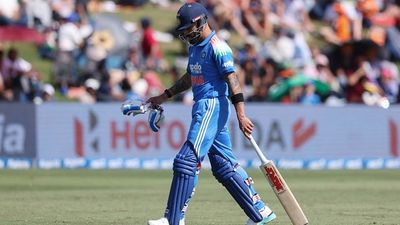
Virat Kohli recorded an unwanted milestone in the fifth and final ODI against New Zealand at Bay Oval in Mount Maunganui on November 15, equalling his career-worst tally for the most dismissals in single-digit scores in a single ODI series or tournament. Dismissed for just 5 runs off 7 deliveries, the veteran right-hander fell into single figures for the third consecutive innings—and the third time in the series, marking his first such slump in 11 years.
ADVERTISEMENT
Virat Kohli falls cheaply again
The embarrassing record was notched during another difficult batting display for India, who were bowled out for 209 in 42.1 overs after being asked to bat first in the series decider. With the 2027 ODI World Cup in South Africa on the horizon, the recurring collapses of India's top and middle order against seam and bounce have raised big tactical question for head coach Gautam Gambhir and the team management.
Entering the fifth ODI with the series locked at 2-1 in India's favor after a washout in Hamilton and a heavy 244-run defeat at the same Mount Maunganui venue two days earlier, India needed stability at the top. New Zealand captain Mitchell Santner won the toss and opted to bowl first, allowing his seamers to exploit early movement and uneven bounce.
Rohit Sharma fell in the sixth over for 7, bringing Kohli to the crease with India at 23/1. Kohli began briskly, collecting 5 runs off his first six balls, before encountering a short, wide delivery outside off stump from seamer Matthew Fisher in the eighth over. Rather than leaving the ball or keeping it down, Kohli attempted an expansive cut and slash. The ball caught an outside edge, flying cleanly to wicketkeeper Tim Seifert, who completed a diving catch. Kohli walked back for 5 off 7 balls with India reduced to 33/2 in 7.3 overs, leaving the middle order exposed inside the first powerplay.
An Eleven-year low: Kohli's single-digit slump
Kohli's departure for 5 meant he had been dismissed for single-digit scores three times in the 2026 tour of New Zealand—7 in the second ODI in Wellington, 0 in the fourth ODI in Mount Maunganui, and 5 in the fifth ODI at the same ground. Across an ODI career spanning more than 300 appearances since his debut in August 2008, Kohli has now suffered three single-digit dismissals in a single series or tournament on only four occasions, and this was the first time it had occurred since early 2015.
| Series / Tournament | Year | Single-Digit Scores | Context |
| ICC Cricket World Cup | 2011 | 8, 1, 9 | Multi-nation tournament (India, Sri Lanka, Bangladesh) |
| Pakistan Tour of India | 2012–13 | 0, 6, 7 | Bilateral series (Chennai, Kolkata, Delhi) |
| Carlton Mid ODI Tri-Series | 2014–15 | 4, 8, 9 | Multi-nation series in Australia (also had 3*) |
| India Tour of New Zealand | 2026 | 7, 0, 5 | Bilateral series (Wellington, Mount Maunganui) |
For more than a decade between the 2015 tri-series in Australia and the 2026 tour of New Zealand, Kohli's consistency in the 50-over format prevented him from enduring three sub-10 dismissals in a single campaign. Notably, his last occurrence in a strictly bilateral series had been against Pakistan during the winter of 2012–13, nearly 14 years ago.
Kohli's Trajectory Across the 2026 New Zealand Series
Kohli's series returns highlight a stark contrast between his opening innings and his subsequent three outings:
1st ODI (Auckland, Nov 4): 74 off 51 balls — Kohli looked in commanding touch at Eden Park, anchoring India's successful five-wicket chase (via the DLS method) with brisk strokeplay.
2nd ODI (Wellington, Nov 7): 7 off 7 balls — In a rain-shortened contest where India scraped home by four runs (DLS), Kohli fell early while trying to force the pace.
3rd ODI (Hamilton, Nov 10): Match abandoned — Persistent rain washed out the game at Seddon Park without a ball bowled.
4th ODI (Mount Maunganui, Nov 13): 0 off 4 balls — Chasing 334, India collapsed to 0/3; Kohli was dismissed for a duck alongside Rohit Sharma in the same ODI for the first time since 2010 as New Zealand's Matt Henry ran through the top order.
5th ODI (Mount Maunganui, Nov 15): 5 off 7 balls — Caught behind off Matthew Fisher.
In total, Kohli finished the tour with 86 runs across four innings at an average of 21.50. Entering the series needing 103 runs to reach 2,000 ODI runs against New Zealand, he fell 17 runs short of the landmark.
Kohli's Broader Record on New Zealand Soil
The 2026 tour represents an uncharacteristic dip compared to Kohli's historical output in New Zealand. Prior to this series, he had accumulated 596 runs in 13 ODIs on New Zealand soil at an impressive average of 49.66 and a strike rate of 91.41, including one century (a highest score of 123) and four half-centuries.
Across his overall ODI career against New Zealand—both home and away—Kohli remains the highest run-scorer in bilateral history between the two nations. However, adding his 86 runs from the four completed matches in November 2026 (bringing his tally in New Zealand to 682 runs in 17 innings at an average of 42.62) underscores how unusually vulnerable he looked against the extra bounce and lateral seam movement at Wellington and Mount Maunganui.
India's batting collapse to 209 in the fifth ODI
Kohli's early exit was symptomatic of a wider top-order failure in the series finale. After Rohit Sharma (7) and Kohli (5) departed inside eight overs, Ruturaj Gaikwad (18 off 27 balls) edged Jacob Duffy behind in the ninth over, leaving India reeling at 34/3.
Captain Shreyas Iyer (22) and Axar Patel attempted a cautious recovery, pushing the total past 100 before Iyer fell to Blair Tickner. Axar Patel played with composure to compile 46 off 55 balls (five fours, one six), anchoring the middle overs before slicing Michael Bracewell to Will Young. Wicketkeeper-batter Ishan Kishan matched Axar's top score with a fighting 46 and shared a 39-run stand with Naman Dhir (22), temporarily lifting India to 155/5 in the 32nd over.
Once left-arm spinner Mitchell Santner (3/47) broke through by removing Dhir, Auqib Nabi (5), and debutant Yash Thakur (0), India slipped to 166/8. Late lower-order hits from Arshdeep Singh (14) and Mohammed Siraj (14 not out) carried the team past 200 before Jacob Duffy (3 wickets) bowled Arshdeep to wrap up the innings at 209 all out in 42.1 overs—leaving 47 deliveries unused.
Mounting Batting Concerns Ahead of the 2027 ODI World Cup
India's inability to bat out their 50 overs at Bay Oval—just 48 hours after being bowled out for 89 in 26.4 overs at the same venue—has sharpened scrutiny on the side's preparation for the 2027 ODI World Cup in South Africa.
Head coach Gautam Gambhir acknowledged the urgency of the issue following the fourth ODI, noting that New Zealand's pace-friendly pitches closely mirror the conditions India will face in South Africa in 2027. Across the series, India's batting unit displayed three recurring vulnerabilities:
Fragility against new-ball seam movement: Whether facing Matt Henry's wobble-seam deliveries in the fourth ODI or Matthew Fisher and Jacob Duffy's disciplined lines in the fifth, India's top three repeatedly surrendered early wickets, forcing the lower middle order into damage-control mode before the 10th over.
Over-reliance on Senior Anchors: With Rohit Sharma managing just 30 runs across the entire series and Kohli restricted to a single half-century followed by three single-digit scores, the absence of big runs from the senior duo exposed the relative inexperience of the surrounding batting group.
Failure to utilise full overs: Being dismissed in 26.4 overs in the fourth match and 42.1 overs in the fifth highlighted a lack of middle-over tempo control and partnership building.
Jagran Josh
As India moves closer to the 2027 World Cup cycle, bridging the gap between aggressive intent and technical resilience on seaming tracks remains the primary challenge for both Kohli and the broader Indian batting lineup.
ADVERTISEMENT