





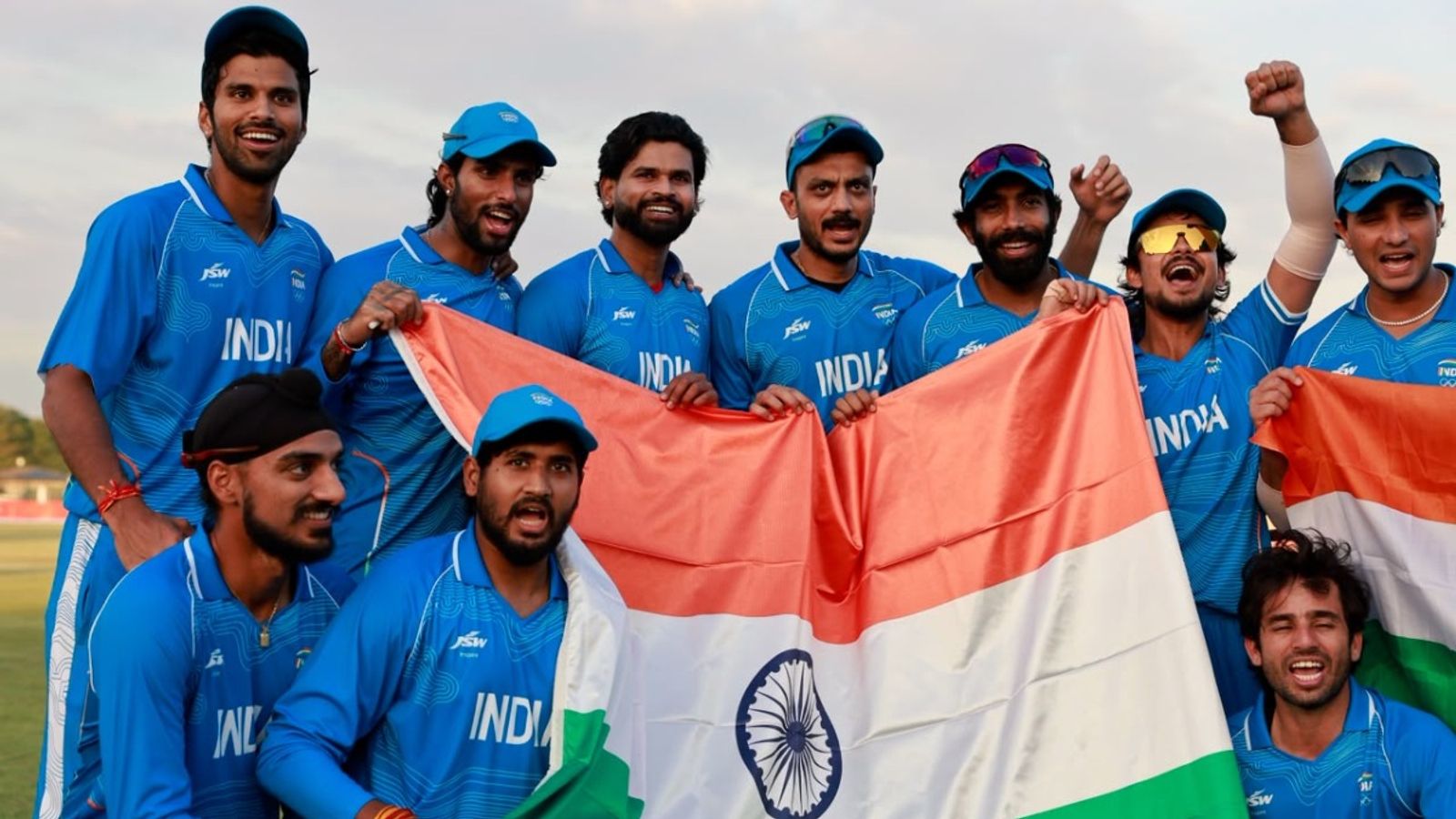
In the modern cricketing landscape, supremacy is no longer defined merely by winning key matches, it is established through total, unyielding dominance over entire continents. On October 3, 2026, Shreyas Iyer-led Team India delivered a big statement at the Asian Games 2026 in Nagoya, Japan, securing a second consecutive gold medal with a 19-run win over so-called arch-rivals Pakistan.
Defending 211/6, built on explosive knocks from Abhishek Sharma (61) and Tilak Varma (51*), India held Pakistan to 192/6 despite a fighting 96 from Hasan Nawaz. The triumph went far beyond adding another piece of silverware to the trophy cabinet. It underscored an inescapable reality, the gulf between India and the rest of Asia has widened into a chasm that no competitor looks remotely equipped to bridge.
India defend Asian Games 2026 gold to become Asian giants
India’s Gold Medal in Nagoya is not an isolated high-water mark, it is the natural culmination of relentless, multi-format success. Over the past three years, India’s white-ball machinery has operated at an unprecedented level of efficiency. Across T20 Internationals, the Men in Blue have consistently maintained a win percentage exceeding 75 per cent, establishing a brand of cricket defined by fearless power-hitting upfront and relentless, tactical bowling during the middle overs.
What makes this reign so formidable is India’s unparalleled structural depth. While other nations struggle to form a reliable core of 15 players, India’s talent pipeline yields multiple elite line-ups capable of controlling global tournaments. Whether deploying senior mainstays like Jasprit Bumrah or empowering explosive young talent such as Abhishek Sharma and Shivam Dube, India’s execution remains uncompromising. Their campaign in Japan reflected this exact brand of dominance: taking initial control with the bat, applying pressure early with the ball, and executing under pressure during high-stakes moments.
From turbulence to glory: The Shreyas Iyer story
Central to this campaign was the leadership of Shreyas Iyer. Iyer’s journey to captaining the national side to Asian Games gold was anything but straightforward. Following central contract uncertainties, injury setbacks, and early skepticism regarding his tactical leadership in international fixtures, his initial transition into the captaincy role carried high pressure.
Lokmat.com
Early stumbles under his tenure, which saw embarrassing series defeats against Ireland and England, raised valid questions on his leadership acumen. However, Iyer responded by refining his leadership style with composure and clear intent. He empowered his top order to attack without fear, backed spinners Axar Patel and Washington Sundar in high-leverage situations, and maintained composure when opposition partnerships threatened to alter the momentum.
Iyer’s proactive leadership during the final was evident: when Pakistan threatened a comeback midway through their chase, his precise bowling changes, bringing back Shivam Dube to break an 87-run partnership—swiftly wrested control back in India's favor. By leading the squad to gold without dropping a single fixture, Iyer has silenced critics and established himself as a calm, tactically astute leader.
The Asian Field: A growing competitive chasm
While India continues to set benchmark standards, the rest of the Asian cricketing elite remain stuck in cycles of inconsistency.
| Country | Asian Games Result | Primary Structural Challenge |
| Pakistan | Silver Medal | Vulnerable middle order, bowling inconsistency under pressure |
| Sri Lanka | Bronze Medal | Batting collapses against top-tier bowling attacks |
| Bangladesh | 4th Place | Stagnant power-hitting, lack of fast-bowling depth |
Pakistan?
Pakistan settled with silver medal, but their path laid bare deep-seated systemic issues. Despite individual brilliance, such as Hasan Nawaz’s stunning 96 off 51 balls in the final, the team lacks tactical cohesion and depth. Their reliance on individual brilliance rather than structured team performances leaves them repeatedly coming up short against India's complete roster.
Sri Lanka?
Sri Lanka secured Bronze with a comfortable 63-run win over Bangladesh, showcasing flashes of quality through bowler Nuwan Thushara. Yet, their top order remains chronically inconsistent against high-caliber bowling attacks. They lack the scoring rate required to challenge India’s typical totals of 200+.
Bangladesh?
Bangladesh continues to struggle on high-scoring surfaces. Bundled out for just 102 runs in the Bronze medal playoff, their persistent inability to produce high-strike-rate batters leaves them non-competitive against premier modern teams.
No competition for undisputed Kings' India, Period!
The Asian Games 2026 campaign confirmed what recent bilateral and tournament records have increasingly signaled: Indian cricket operates in a tier of its own. Backed by an unparalleled domestic infrastructure, a deep bench of match-winners, and a settled leadership under Shreyas Iyer, the Men in Blue have set the gold standard. As the rest of the continent searches for answers, India stands unchallenged at the summit of Asian cricket.
We couldn't practise for almost a week: Iyer hails India's champions mindset
India’s path to the Asian Games podium was met with immediate disruption upon landing in Japan on September 20. Heavy downpours continually thwarted their schedule, forcing the squad into makeshift indoor conditioning sessions while waiting out nearly a week of relentless rain. Following a brief five-over match in Sano on September 22, the team journeyed to Nagoya, only to have their quarterfinal against Afghanistan completely washed out on September 28. Despite not securing a full training session until October 1, on the eve of their semifinal against Sri Lanka, the group refused to let the adverse conditions alter their focus.
For captain Iyer, the team’s unwavering composure amid logistical setbacks revealed their true strength long before the decisive matches began. Rather than dwelling on the lack of match practice, the squad stayed locked into their physical preparation and adapted seamlessly to the situation. Reflecting on the journey after a hard-fought 19-run win over Pakistan in Saturday's gold-medal match, Iyer expressed his pride in the group's attitude. He emphasized that their willingness to overcome obstacles without making excuses was the defining quality of a champion side, culminating in a gold-medal performance that truly reflected their internal resilience.
"If have to use a word, I would say, 'ecstatic'. Since the day we arrived in Japan, it was raining cats and dogs and we couldn't practise for almost a week. But the boys, the way they prepped themselves and also we were doing our training on the side. We didn't complain, we didn't give any reason," Iyer said after the match.
"So that was a sign of a champion itself, champion team. And today was just a reflection of that," he added.