



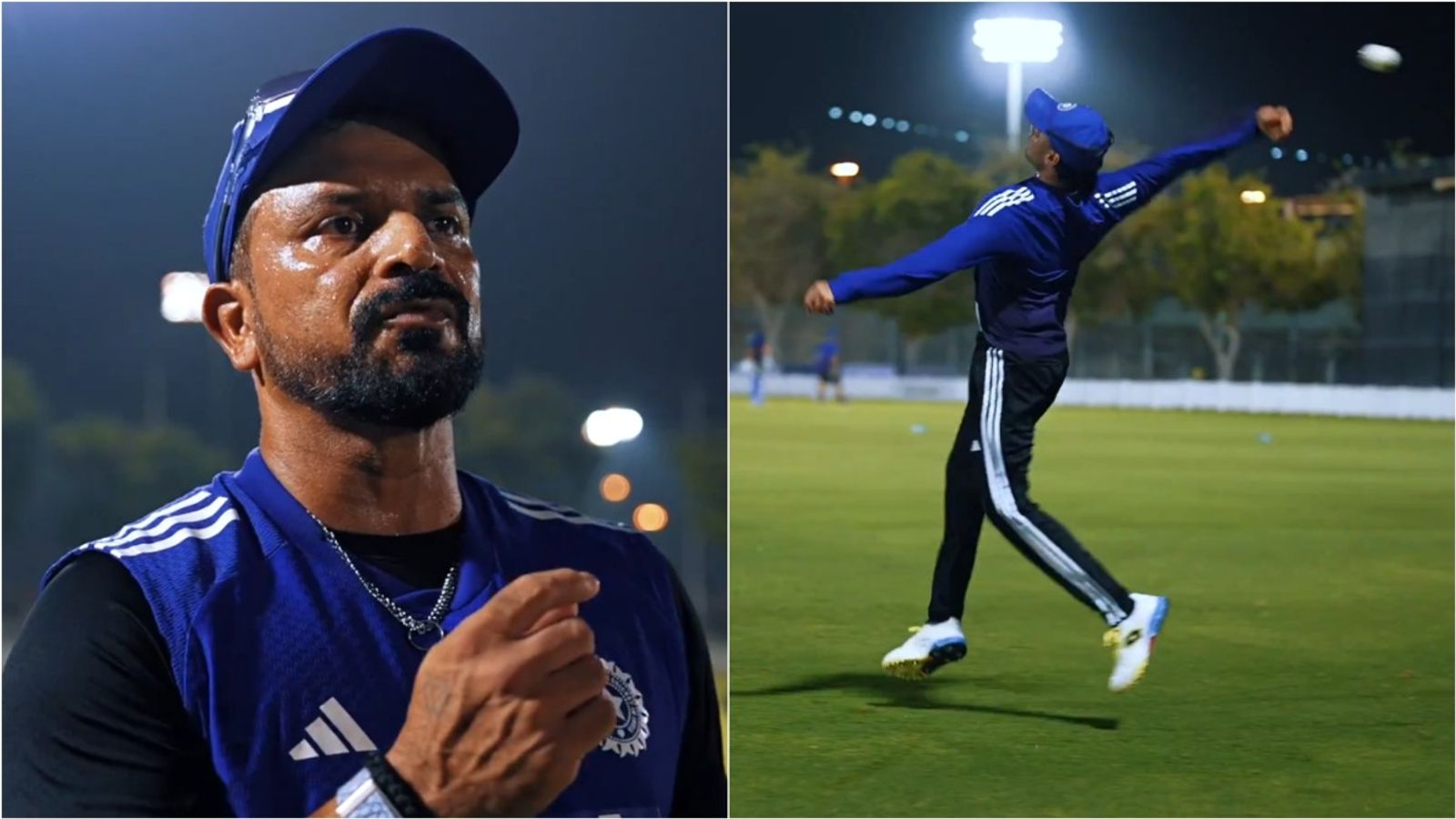
India men's team's fielding coach T Dilip has said that taking high catches at the Dubai International Stadium is a challenge for fielders because of the layout of the floodlights. Ahead of the clash against Oman, the BCCI released a video in which Dilip talked about the 'ring of fire' at the venue which forms making it tough for boundary rides to sight the ball.
"One of the challenges we encounter in Dubai Stadium is the lights are slightly different. It's more of a ring of fire which are in the dome basically rather than on the poles, which we usually come across.
"The challenge in the ring of fire is especially on outfield boundary line catches. There is a tendency that you lose sight of the ball for a split second, especially when the ball is travelling through that or coming through it," said Dilip.
Another challenge that players have been facing in the ongoing T20 Asia Cup 2025 is humidity. He feels that the players need to be switched on in high-intensity games.
"It's all about how players are switched on at that particular moment and how they respond to that particular ball which is very very important considering the humidity in Dubai and especially in T20 which is very high-intense game," added Dilip.
How Dilip is preparing fielders to counter Dubai’s challenges
He explained how humidity makes it tough for players to take catches. He compared how the ball drops in humid conditions compared to different weather. He has incorporated drills to help players prepare and avoid any costly drops. In the drills, players are told to look at the boundary rope when the ball is in the air to avoid panicking when they lose sight of it in 'ring of fire'.
"And, another challenge is humidity and density. The depth and perception of high catches over a period, the drop becomes different compared to other places.
"We have been taught throughout our life (to) always watch the ball, and as soon as you don't see the ball for a split second you tend to panic. So, what we try to do in practice sessions is to add variable practices. Then, slowly the players realise that even if you lose a split second in the (flood)light, you still have a lot of time," he said.
"Another factor which differentiates on the ground on that particular day is the speed at which they (fielders) can reach the ball, which makes a lot of difference because they practice so hard for the hands to work out... and feet going near to the ball is also very important," he explained.
Will Bumrah be rested for Oman game?
India will face Oman for the first time in international cricket. It will be interesting to see whether Jasprit Bumrah is rested and India’s leading wicket-taker in T20Is gets a chance ahead of Super 4 Pakistan clash. India may look to bat first if captain Suryakumar Yadav wins the toss as batters need much-needed game time before the next stage.