



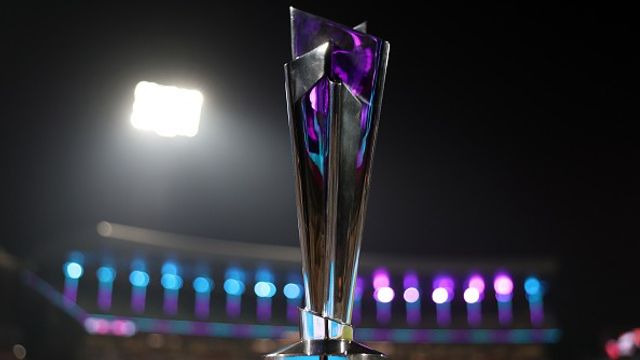
The landscape for the ICC's T20 World Cup 2028 has already started taking shape as the venues for the showpiece tournament's final and semifinals have been disclosed. The iconic Melbourne Cricket Ground (MCG) is set to host the high-stakes final of the T20 World Cup 2028, as per a 9News report. Jointly hosted by Australia and New Zealand, the next edition of the T20 World Cup will run across eight host cities. Along with venue updates, the International Cricket Council (ICC) announced a major format overhaul following its Annual General Meeting in Edinburgh. Introducing a new Super 10 phase and cross-pool eliminator matches, the 2028 tournament promises high-intensity cricket from the opening group stage through to the grand finale.
ALSO READ: India announce unfit Prasidh Krishna’s replacement for 1st three ODIs vs New Zealand
MCG slated to host T20 World Cup 2028 final; Perth in frya for semifinal
The Melbourne Cricket Ground (MCG), with its capacity of roughly 100,000 spectators, stands out as Australia’s premier sporting colosseum. The 2028 final will mark the second time the MCG hosts the Men's T20 World Cup final, having staged the 2022 summit clash where England defeated Pakistan. The ground holds an unequaled historical portfolio, having previously hosted the 1992 and 2015 Men’s ODI World Cup finals as well as the landmark 2020 Women’s T20 World Cup final.
While the ultimate match is bound for Melbourne, the path to the finals will span both host nations:
Optus Stadium (Perth): Perth’s Optus Stadium has emerged as a frontrunner to host one of the two semifinals. Beyond its modern, state-of-the-art facilities, Perth offers a distinct broadcast advantage. Its western time zone aligns seamlessly with primetime television slots in India, making it an ideal venue choice should India qualify for the final four.
T20 World Cup 2028's other semifinal to be staged in New Zealand
New Zealand Knockout: The second semifinal is set to cross the Tasman Sea to New Zealand. While exact stadium allocations remain pending ICC confirmation, major metropolitan hubs, Auckland, Christchurch, and Wellington, are the primary candidates to host the fixture. Sydney and Adelaide Exclusions: Premium knockout fixtures will bypass two traditional Australian heavyweights. Sydney and Adelaide are unlikely to receive semifinal hosting rights.
The absence of Adelaide Oval from the list of premium knockout host venues has drawn attention. Despite holding a rich history, having hosted a 2015 ODI World Cup quarter-final and the 2022 T20 World Cup semifinal where England bested India, Adelaide was not selected for either a semifinal or the final for 2028.
Reports attribute this omission to administrative disputes between state bodies and Cricket Australia (CA) over plans to privatise the Big Bash League (BBL). CA approved a framework enabling individual state associations and clubs to sell commercial stakes in their respective Team Participation Agreements (TPAs). Several state associations opposed this privatization strategy, with South Australia (Adelaide) voicing notable concerns. This commercial friction is widely cited as the underlying cause behind Adelaide Oval missing out on the tournament's top-tier matches.
The 2028 tournament features 55 matches played across eight host cities. While the ICC has not officially finalized the exact match division, the host allocation utilizes existing major stadium networks:
Australian Venues: Five venues across the continent are slated to host matches: Melbourne, Sydney, Adelaide, Perth, and Brisbane.
New Zealand Venues: Three key cities—Auckland, Christchurch, and Wellington—will represent New Zealand’s hosting contribution. This combined footprint provides the structural foundation required to manage the logistical demands of a 20-team international event.
Revamped tournament structure
At its Annual General Meeting in Edinburgh, the ICC ratified significant structural alterations to the Men’s T20 World Cup format, debuting in 2028. Designed to enhance late-stage competitive balance and guarantee that higher-performing nations play more meaningful fixtures, the competition moves away from the previous Super Eight setup.
Stage 1: The Expanded First Round (5 Groups of 4)
While the tournament retains its 20-team roster, the initial group distribution undergoes a structural change: Group Formation: Instead of four groups of five teams, the 20 nations will be separated into five groups of four teams. Match Reduction: The first stage features 30 total matches, down from the 40 matches required under the old format.Qualification: The top two teams from each of the five groups advance directly to the secondary phase.
Stage 2: The Super 10 Stage (2 Groups of 5)
Replacing the Super Eight system, the second round expands to a Super 10: Structure: The 10 qualifying nations will be placed into two pools of five teams each.
Round-Robin Format: Teams will play a complete round-robin against the other four sides in their assigned Super 10 pool, producing 20 matches in total.
Stage 3: Direct Qualification and Cross-Pool Eliminators
The most notable innovation appears in the transition from the Super 10 to the semifinals:Direct Semifinal Qualification: The teams that finish 1st in Group A and Group B of the Super 10 bypass the playoff phase and secure direct entry into the semifinals.
To decide the remaining two semifinal berths, the teams finishing 2nd and 3rd in each Super 10 group will collide in two high-stakes eliminators.
Eliminator 1: 2nd Place (Super 10 Group A) vs 3rd Place (Super 10 Group B)
Eliminator 2: 2nd Place (Super 10 Group B) vs 3rd Place (Super 10 Group A)
The victors of these two eliminators complete the four-team semifinal field.
Comparison: Old vs new T20 World Cup
| Feature | Previous Format (2024–2026) | New Format (2028 Onward) |
| Total Teams | 20 Teams | 20 Teams |
| First Round Format | 4 Groups of 5 Teams | 5 Groups of 4 Teams |
| First Round Matches | 40 Matches | 30 Matches |
| Second Round Stage | Super 8 (2 Groups of 4) | Super 10 (2 Groups of 5) |
| Second Round Matches | 12 Matches | 20 Matches |
| Playoff / Knockout Additions | None (Direct Top 2 to Semis) | 2 Cross-Pool Eliminator Matches |
| Total Tournament Matches | 55 Matches | 55 Matches |
The updated framework balances group stage efficiency with late-stage excitement. Smaller groups of four accelerate the pace of the opening round, reducing the occurrence of lower-stakes group games and ensuring every fixture carries immediate qualification consequences. Direct semifinal passage for Super 10 group winners provides a tangible reward for top-tier consistency throughout the second stage. The cross-pool eliminators prevent a single narrow loss in the Super 10 from eliminating a top contender, while creating knockout intensity ahead of the final four.