



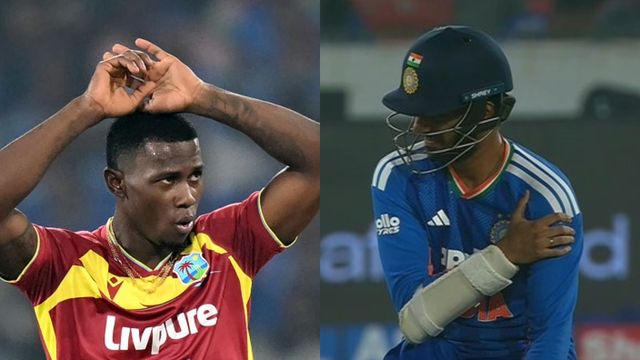
The fourth T20 International between India and the West Indies at the Rajiv Gandhi International Stadium in Hyderabad witnessed an ugly flashpoint during the closing moments of the match. Fast bowler Shamar Joseph found himself at the center of a brewing storm after repeatedly targeting No. 11 batter Arshdeep Singh with short-pitched bodyline deliveries in the final over, culminating in a painful injury that forced the Indian bowler off the field.
The incident drew widespread criticism from former players and cricket analysts, led prominently by Indian batting legend Sunil Gavaskar and former wicketkeeper-batter Shreevats Goswami. Both experts slammed Joseph’s bowling tactics as unnecessary and contrary to the fundamental spirit of the game, sparking a heated debate across the cricketing fraternity.
How Arshdeep Singh's injury unfolded in last over drama
Chasing a colossal target of 248 runs set by the West Indies, India found themselves on the brink of defeat entering the final over. The hosts needed a improbable 35 runs off six balls with just one wicket remaining. Tailender Arshdeep Singh was at the striker's end, with Mayank Yadav standing at the non-striker’s end.
Shamar Joseph was handed the ball to finish the match. Arshdeep gave India a faint glimmer of hope by top-edging the first delivery over the boundary for four. What followed next shifted the tone from competitive intensity to outright concern.
Off the second ball, Joseph bowled a searing short delivery that struck Arshdeep directly on the arm and shoulder region. The Indian pacer immediately collapsed to the ground in severe discomfort, prompting the team physio to rush out to the middle. After receiving treatment, Arshdeep bravely decided to continue batting.
However, Joseph did not back down from his short-ball strategy. As Arshdeep backed away to create room on the subsequent delivery, Joseph adjusted his line and followed the batter, targeting his body once again with another hard-length delivery. Visibly writhing in pain and unable to grip the bat properly, Arshdeep was forced to stop.
Seeing the bowler’s distress and keeping in mind the crucial series decider ahead, Indian captain Shreyas Iyer signaled from the dugout for Arshdeep to retire hurt. With the last batter unable to proceed, India’s chase officially ended at 213 in 19.3 overs, handing the West Indies a 24-run victory and bringing the five-match series to a 2-2 deadlocks.
Sunil Gavaskar and Shreevats Goswami react
Watching the drama unfold from the commentary box, Gavaskar was deeply unimpressed by Joseph's decision to continue aiming short balls at a tailender who was clearly hurt. Gavaskar voiced his frustration over the lack of tactical necessity, arguing that against a lower-order batter with 35 runs required off five balls, targeting the stumps was the most sensible option.
"If he is not ok, he should retire. He seems to be in pain. You do not want to aggravate that injury," Gavaskar noted when Arshdeep was first struck.
When Joseph followed up with another bodyline delivery, Gavaskar expressed his exasperation live on air:
"Would it not be simpler to just aim at the stumps? He knows that he is moving away to the left. Just aim at the stumps. Don’t aim at him. He is aiming at him. Why attack the batter when the stumps are right there?," he added.
Joining Gavaskar in calling out the West Indian pacer, former IPL wicketkeeper-batter Shreevats Goswami posted his critique on social media, accusing Joseph of intentionally trying to hit the batter rather than closing out the game:
"What Shamar Joseph did in the last 3 balls against Arshdeep is not in the spirit of the game for me. Arshdeep was never going to win it for India from that situation. I know it’s a battle out there, but he could have just bowled it on the stumps instead of trying to follow, and it looked like he was purposely trying to hit him. Not on," Shreevats stated.
Sanju Samson's big update on Arshdeep Singh's injury
Following the conclusion of the match, wicketkeeper-batter Sanju Samson provided an update on Arshdeep's injury during the post-match press conference. Samson confirmed that Arshdeep was receiving immediate medical attention in the dressing room and was applying ice packs to his shoulder and upper arm area to reduce inflammation.
"Arshdeep is putting ice on his shoulders. Hopefully he gets well soon. He got struck by a high-speed ball. Hope he recovers soon," Samson said.
While the team management expressed hope that the injury was primarily soft-tissue bruising rather than a structural fracture, his availability for the fifth and final T20I at the M. Chinnaswamy Stadium in Bengaluru remained subject to assessment by the medical team over the subsequent 48 hours.
Individual Performances: Arshdeep Singh vs. Shamar Joseph
Both fast bowlers endured statistically tough outings in what turned out to be an absolute paradise for batters in Hyderabad.
| Player | Overs | Runs conceded | Wickets taken | Economy Rate |
| Arshdeep Singh | 4 | 52 | 1 | 13 |
| Shamar Joseph | 2.3 | 47 | 0 | 18.8 |
For the West Indies, Shamar Joseph had a night to forget with the ball despite his team securing the win. He was repeatedly taken to the cleaners by Indian top-order batters, conceding 47 runs in just 2.3 overs without picking up a single wicket. His overall tour of India had already been challenging, having registered an economy rate exceeding 14 across the T20I matches.
Arshdeep, on the other hand, fared marginally better by claiming one wicket, but still proved expensive. He surrendered 52 runs in his four-over spell as Shai Hope’s magnificent unbeaten 102 carried the West Indies past the 240-run mark.
Arshdeep’s ongoing bowling woes in the series
While the controversy surrounding Joseph's tactics took center stage, Arshdeep’s ongoing struggles with the ball have become a growing cause for concern for India. In the absence of senior speedster Jasprit Bumrah, Arshdeep was entrusted to lead the Indian pace attack. However, his execution, particularly in the powerplay and the death overs—has lacked consistency throughout the five-match rubber.
Across the four T20Is played so far, Arshdeep has consistently leaked runs at an alarming rate. Outside of a match-winning spell of 3 for 44 in the third T20I where he dismissed key batters Shai Hope and Sherfane Rutherford, he has struggled to contain the aggressive West Indian top order.
Conceding runs at an economy rate well above 10 runs per over throughout the series, his tendency to miss yorker lengths under pressure and bowl boundary balls has contributed directly to West Indies posting massive, 200-plus totals repeatedly. As India prepares for the series decider in Bengaluru, fixing these defensive lines and restoring bowling discipline will be just as critical as ensuring Arshdeep’s full physical recovery.