

 Home


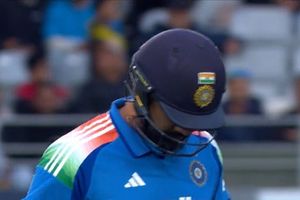
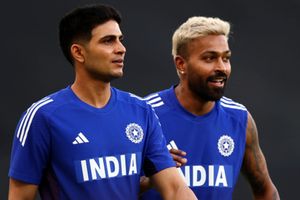
Shubman Gill was at the centre of attention because of a 'Temple device' which he wore during first One Day International (ODI) between India and New Zealand at Eden Park, Auckland. Sharp-eyed cricket fans and commentators quickly noticed something unusual about Indian captain Shubman Gill. Attached to the side of his forehead, just near his temple, was a compact, sleek wearable sensor.
ADVERTISEMENT
Shubman Gill's 'Temple Device' sparks curiosity in Auckland
The small black device immediately ignited intense curiosity across social media and broadcast panels. Fans wondered whether the top-order batter was wearing a continuous glucose monitor, an advanced biometric sensor, or an unauthorised piece of tech.
The mystery headgear turned out to be Temple, a cutting-edge performance wearable developed by a health-tech startup backed by Zomato co-founder and CEO Deepinder Goyal. Designed specifically for elite athletes, the device has also been endorsed by Olympic badminton champion PV Sindhu, who described it as a total "game changer" for her training regimen.
How does the Temple Device work?
Unlike standard smartwatches or chest bands that rely solely on heart rate monitoring via wrist pulse, the Temple device directly targets the central nervous system's response under pressure.
Cerebral Blood Flow Tracking: Positioned on the side of the forehead, Temple utilizes non-invasive optical sensors (a technology suite dubbed BrainFlow) to measure real-time changes in blood volume and oxygenation flowing to the brain.
Cognitive Workload & Stress Metrics: By monitoring brain hemodynamics, the wearable evaluates an athlete's cognitive strain, focus level, and mental fatigue during high-stress activities.
The Entropy Score: The system calculates a proprietary "Entropy Score," which measures overall physiological and neurological strain. This allows trainers and athletes to see how factors like intense exertion, heat, hydration, and high-pressure decision-making impact the athlete's cognitive bandwidth.
For a batter like Shubman Gill, who must process split-second delivery cues while retaining laser-sharp focus, tracking cognitive load and mental recovery offers invaluable insights during training and match preparation.
ICC rules on wearables and in-game commercial devices
The sighting of the device on an international cricket pitch naturally raised regulatory questions regarding International Cricket Council (ICC) compliance.
1. Real-Time Data Transmission & Anti-Corruption (PMOA Rules)
Under the ICC Player and Match Officials Area (PMOA) Regulations, players are strictly prohibited from using electronic communication devices capable of transmitting or receiving data during a live match.
Passive vs. Active Tracking: If a wearable operates as a passive data logger (storing metrics internally to be synced via Bluetooth after the game), it is generally permitted for fitness monitoring.
Live Transmission: However, if the device transmits live telemetry to dugout computers, analytical staff, or external servers during play, it violates ICC anti-corruption and real-time assistance rules unless explicit prior authorization has been granted by the match referee.
2. Commercial & Clothing Regulations
The ICC's Clothing and Equipment Regulations govern what hardware can be worn on the field:
Approved Medical & Fitness Hardware: Passive biometric trackers (like GPS vests or heart rate bands) worn under jerseys are standard. However, visible devices worn on exposed skin—such as the forehead—must receive technical clear-outs so as not to cause distraction or safety hazards.
Ambush Marketing Restrictions: Devices featuring visible commercial branding or unapproved personal sponsor logos are strictly barred under ICC ambush marketing guidelines. If a wearable displays unapproved commercial logos on camera, the player or team can face disciplinary fines under the ICC Code of Conduct.
ALSO READ: Virat Kohli breaks Sachin Tendulkar's all-time record for most runs in ODI run chases
India take 1-0 lead in series with 5-wicket thrashing of New Zealand in 1st ODI
While the off-field tech debate generated headlines, India delivered a clinical performance on the field to outclass New Zealand by five wickets at Eden Park, taking a 1-0 lead in the five-match series.
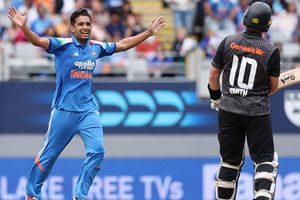
Electing to bowl under overcast conditions, India’s seam attack completely paralysed the Blackcaps. Haryana fast bowler Anshul Kamboj delivered a masterclass in seam control, picking up 2/22 in his 10 overs (including two maidens) at an astounding economy rate of 2.20. Left-arm pacer Arshdeep Singh swept through the rest of the order with 4/70, bundling out New Zealand for a modest 185 in 40.2 overs.
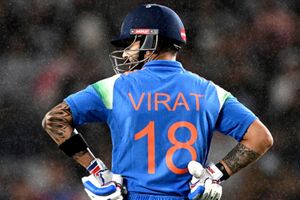
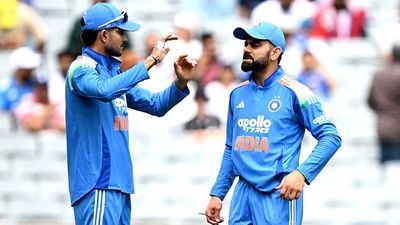
Following a brief rain interruption that revised the target via the DLS method, India stumbled early as Rohit Sharma fell for a duck. However, Virat Kohli anchored the chase with a silky 74 off 51 balls (13 fours, 1 six), supported by Shubman Gill’s composed 37 off 56 balls. India raced to 143/5 in 22.4 overs, sealing a comfortable 5-wicket victory with 56 balls to spare.
Following India's emphatic victory, skipper Shubman Gill praised his bowling unit's relentless discipline and emphasized the team's broader ambitions:
"[On India's bowling and fielding performance] I think we were very good with the bowling. And I think our fielding was also really good. That run out by Rohit bhai, I think changed the momentum of the game. I think it was really that partnership (Mitchell & Phillips), we saw that even in India - those two batted really well in India. And overall I think a very good team performance for us. [On Anshul Kamboj and Gurnoor Brar's performances] I mean Anshul is the kind of a bowler, I think he's tailor-made for these kind of conditions, always nippy, trying to seam the ball. And good with the old ball. We felt when there's not much happening from the wicket, he (Brar) can create that extra bounce and with his pace and the way both of them bowled tonight was really magnificent to watch," Gill said at the post-match presentation.
When and where to watch IND vs NZ 2nd ODI?
The 2nd ODI between India and New Zealand takes place on Saturday, November 7, 2026. The match will be played in Wellington, New Zealand.
Match Timings
Start Time: 7:30 AM IST (3:00 PM local time / 02:00 AM GMT)
Toss Time: 7:00 AM IST
Live Streaming & Telecast DetailsIn India:
Fans in India can live stream the 2nd ODI on the SonyLIV app and website.TV Broadcast: The match will be broadcast live on the Sony Sports Network channels (Sony Sports Ten 1, Sony Sports Ten 3, Sony Sports Ten 4, and Sony Sports Ten 5).In New Zealand:TV & Streaming: Live broadcast and digital streaming will be available on TVNZ+ and Sky Sport NZ.
International Broadcasters:
UK: TNT SportsUSA & Canada: Willow TVAustralia: Foxtel / Kayo Sports
ADVERTISEMENT