

 Home


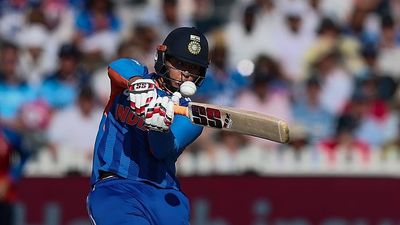
Ishan Kishan's injury not only came as a setback for India ahead of the second T20I against New Zealand but also triggered a bitter-sweet headache for the selectors as to take this opportunity to draft the currently benched Vaibhav Sooryavanshi in team's playing XI for the crucial encounter or not.
ADVERTISEMENT
As Team India gears up for the second T20 International against New Zealand at the Hagley Oval in Christchurch, tactical blueprints are undergoing a forced revision.
Where Should Sooryavanshi bat if given chance in IND vs NZ 2nd T20I?
The primary catalyst for this shift is an unfortunate injury to explosive wicketkeeper-batter Ishan Kishan, who has been officially ruled out of the fixture due to a groin niggle. Kishan’s absence clears the technical pathway for Sooryavanshi to finally break into the playing XI. However, his inclusion sparks an intense strategic debate: Where should the teenage sensation fit into India's batting order?
Ishan Kishan’s injury opens the door
Ishan Kishan’s unfortunate low-grade adductor strain, picked up during the high-scoring series opener in Christchurch, has left a gaping hole in India's matchday squad. Kishan’s dynamic presence at the top or in the middle order provided stability and fierce momentum.His exclusion forces team management to alter a winning combination. While the squad boasts ample depth, Kishan's sudden unavailability serves as the direct ticket for Sooryavanshi to step out of the shadows of the bench and into the heat of international action on foreign soil.
The fixed opening duo and the bench dilemma
For quite some time, Sooryavanshi has found himself mostly sitting out of India's playing XI. The primary roadblock to his regular inclusion has been the entrenched, immovable opening partnership of Sanju Samson and Abhishek Sharma. Both Samson and Abhishek have delivered match-winning masterclasses, locking down the opening slots with aggressive intent and high-scoring consistency.
This established pairing left minimal room for experimentation, forcing management to prioritize stability over early exposure for the youngster, even as fan noise grew louder with every passing match.
Addressing the Social Media Pressure: Sitanshu Kotak’s Stance
The constant clamor from fans and pundits demanding Sooryavanshi’s inclusion has been a constant talking point. Addressing this heavy public chatter ahead of the second T20I, India’s batting coach Sitanshu Kotak offered a candid and grounded perspective on selection dynamics.
Kotak, at the pre-match press conference, firmly made it clear that team combinations cannot be dictated by public trends, stating:
"You can't make changes to the XI because people like him. He is very talented and I believe he has a bright, bright future ahead. So once he gets his opportunities and settles down, he will learn a lot of things."
Kotak further noted that excessive external hype can place undue pressure on a 15-year-old, while also protecting the morale of established openers who continually perform. Now, with an enforced injury change, the decision is born out of tactical necessity rather than social media pressure.
Sooryavanshi’s phenomenal profile and how big a threat he can become for NZ
If Sooryavanshi is thrust into the playing XI, he represents a terrifying prospect for the New Zealand bowling attack. Despite his tender age, his numbers across premier domestic and franchise platforms highlight a batter who thrives on elite velocity and scoreboard pressure:
Indian Premier League (IPL) Exploits: Across 23 matches for the Rajasthan Royals, Sooryavanshi has hammered 1,028 runs at an extraordinary strike rate of 229.00, averaging 44.70 with a highest score of 103. He has already notched up 2 centuries and 6 half-centuries in the tournament.
Demonstrating rare technical fearlessness against high-end fast bowling, he has scored 804 runs off just 341 balls against pace in franchise cricket at a mind-boggling strike rate of 235.78.Domestic One-Day (DODI) Brilliance: In 23 List A/domestic ODI matches, he has plundered 1,300 runs at a phenomenal average of 59.09 and a strike rate of 161.70, featuring a top score of 175 alongside 3 centuries and 8 fifties.
ALSO READ: MS Dhoni's statemate earns maiden India A call-up, likely to replace KL Rahul in New Zealand A tour
Determining Sooryavanshi's ideal batting order
Where should this explosive phenom slot in? Given his natural template as an ultra-aggressive top-order aggressor who likes to dominate the powerplay, putting him lower down the order at number 5 or 6 would waste his primary skillset. However, because Sanju Samson and Abhishek Sharma are locked into opening duties, with Samson coming off a brilliant 67 off 33 balls in the first T20I, breaking up the established pair carries risk.
The ideal compromise for the second T20I is to slot Sooryavanshi in at number 3. This allows him to protect his preferred aggressive style, take advantage of the remaining powerplay restrictions if an early wicket falls, and gives him a license to unleash his 360-degree strokeplay against both pace and spin without completely destabilizing the team's successful opening formula.
But going by the earlier precedence, Sooryavanshi thrives as an out-and-out opener who likes to take charge of the powerplay. However, accommodating him at the top introduces a familiar selection puzzle regarding how to balance the batting order alongside regular white-ball fixtures. Recalling previous strategic adjustments, there have been instances where both Sanju Samson and Sooryavanshi featured in the playing XI together, most notably during high-profile assignments like the Asian Games 2026. In those matches, Sooryavanshi took charge at the top alongside Abhishek Sharma, which required experienced batter Sanju Samson to adapt and drop down to number 3. During those specific fixtures, Sooryavanshi made an immediate impact with his fearless strokeplay, recording stellar performances, including a brilliant knock of 53 runs off just 21 balls in high-pressure encounters like the semi-final against Sri Lanka, while Samson provided stability in the middle order. Those tactical combinations yielded dominant team displays, helping India successfully dictate terms and march toward tournament victories. If management chooses to replicate that dynamic for the upcoming clash in Christchurch, pushing Samson to one-down to let Sooryavanshi open could give India a fierce, explosive start. Whether they choose to disrupt a winning opening combination or test the youngster lower down remains one of the most intriguing subplots of the series.
But all these talks will only be fructified if Sooryavanshi gets a chance to feature in India's playing XI.
ADVERTISEMENT