



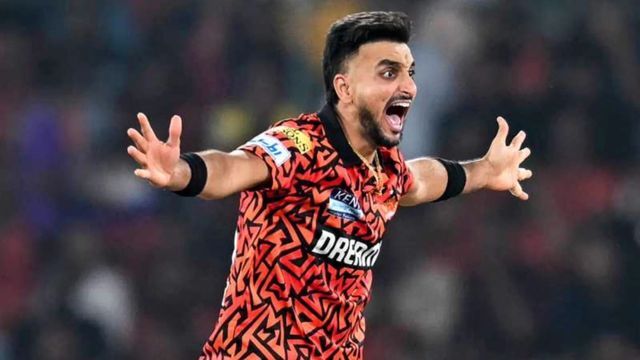
Ahead of the November 17 retention deadline for the Indian Premier League (IPL) 2027 season, Sunrisers Hyderabad (SRH) and Gujarat Titans (GT) have finalised one of the most intriguing transactions of the pre-auction trade window. Two-time Purple Cap winner Harshal Patel is set to leave Sunrisers Hyderabad and join Gujarat Titans in an outright, all-cash deal valued at ₹4 crore.
Unlike several high-profile swaps seen during the 2027 trade window—including SRH’s own four-player blockbuster exchange with Chennai Super Kings—this deal involves no player moving in the opposite direction. While initial discussions between the two franchises reportedly explored a direct player swap involving English wicketkeeper-batter Tom Banton, both sides ultimately settled on a one-way cash transfer.
Understanding why no player was traded in return—and why SRH agreed to let a proven match-winner leave for half his original auction price—requires a closer look at IPL trade mechanics, squad restructuring in Hyderabad, and Gujarat Titans’ tactical blueprint for 2027.
How the ₹4 Crore All-Cash Deal Works?
Under IPL trading regulations, franchises can complete transfers either as player-for-player swaps (with cash adjustments if values differ) or as pure all-cash transactions. In an all-cash trade, the buying franchise pays the agreed transfer fee directly from its auction purse to acquire the player's contract, while the selling franchise receives the corresponding amount back into its available auction budget.
At the IPL 2025 mega auction, Sunrisers Hyderabad spent ₹8 crore to secure Harshal Patel’s services. However, in the deal with Gujarat Titans, his trade valuation has been negotiated down to ₹4 crore—exactly 50 percent of what SRH paid two years ago. Once the Board of Control for Cricket in India (BCCI) formally ratifies the paperwork ahead of the November 17 deadline, ₹4 crore will be deducted from Gujarat Titans’ auction purse ahead of the December 16 mini-auction in Goa, and Harshal will officially join his fifth IPL franchise after stints with Royal Challengers Bengaluru, Delhi Capitals, Punjab Kings, and SRH.
Why no player was traded in return?
During early negotiations between Hyderabad and Ahmedabad, the two franchises did discuss a direct player exchange. Gujarat Titans had acquired 27-year-old English wicketkeeper-batter Tom Banton for ₹2 crore at the 2026 mini-auction, though a finger injury ruled him out of the tournament before he could make his debut. SRH briefly weighed the option of bringing Banton in to add top-order firepower and wicketkeeping cover.
However, SRH’s batting lineup was already well-settled following their third-place finish in IPL 2026, where they won nine of their 14 league matches. Rather than taking on an overseas batter who might struggle to break into their starting XI—and who would occupy a precious overseas slot—SRH opted against bringing a player back, pivoting instead to an all-cash settlement.
Sunrisers Hyderabad have been arguably the busiest franchise in the IPL 2027 trade window, executing a calculated overhaul of their bowling attack. While their batting carried them deep into the 2026 playoffs before an Eliminator loss to Rajasthan Royals, their bowling unit proved vulnerable at critical junctures.
To fix that weakness, SRH brought in left-arm yorker specialist T Natarajan from Delhi Capitals for ₹5 crore, and completed a massive four-player trade with Chennai Super Kings that saw left-arm pacer Khaleel Ahmed (₹4.8 crore) and Australian death-overs specialist Nathan Ellis (₹2 crore) arrive in Hyderabad in exchange for Liam Livingstone and Jack Edwards. With Natarajan, Khaleel, and Ellis joining the pace ranks alongside young domestic prospects, Harshal Patel became surplus to requirements. Taking pure cash in return gives SRH clean financial flexibility heading into the December mini-auction rather than cluttering their roster with an unwanted player.
Harshal’s trajectory at SRH played a decisive role in both his departure and the discounted ₹4 crore price tag. In his debut season for Hyderabad in IPL 2025, the 35-year-old justified his ₹8 crore fee by picking up 16 wickets in 13 matches at an economy rate of 9.80, even becoming the fastest bowler in IPL history to reach 150 wickets in terms of deliveries bowled.
IPL 2026, however, told a starkly different story. Struggling for rhythm and effectiveness on flat pitches, Harshal played just five matches, bowling 13.4 overs and conceding 148 runs at a costly economy rate of 10.82 without claiming a single wicket. The SRH team management eventually benched him in favor of uncapped Indian pacers Praful Hinge and Sakib Hussain, leaving him out of the playing XI for the Eliminator clash against Rajasthan Royals. Had SRH not found a trade partner, they were widely expected to release him back into the auction pool anyway.
For SRH, trading Harshal in a negotiated cash deal ensured they recovered guaranteed value and avoided any awkwardness around releasing a senior Indian international. For Gujarat Titans, completing the deal prior to the auction allowed them to lock in an experienced Indian death bowler at a bargain ₹4 crore—bypassing the unpredictability and bidding wars of a mini-auction where proven domestic fast bowlers routinely command inflated prices.
Harshal Patel’s IPL Snapshot (2025–2026 vs. Career)
| Metric | IPL 2025 (SRH) | IPL 2026 (SRH) | Overall IPL Career |
| Matches | 13 | 5 | 124 |
| Wickets | 16 | 0 | 151 |
| Economy Rate | 9.80 | 10.82 | 8.92 |
| Contract Value | ₹8 Crore | ₹8 Crore | ₹4 Crore (GT Trade) |
What Harshal Patel Brings to Gujarat Titans
For Gujarat Titans, acquiring Harshal Patel is both a tactical fit and a symbolic homecoming. Born in Ahmedabad, Harshal has represented Gujarat at the age-group level before moving to Haryana in domestic cricket, and the transfer finally unites him with his home-state IPL franchise.
On the field, GT finished in the top two during the IPL 2026 league stage under captain Shubman Gill, showcasing a well-drilled squad. Adding Harshal brings a veteran campaigner with 151 IPL wickets in 124 matches (at a career strike rate of 16.6) into their domestic pace attack. While express pace can sometimes sit nicely onto the bat at the Narendra Modi Stadium in Ahmedabad, Harshal’s hallmark variations, dipped slower balls, back-of-the-hand deliveries, and wide yorkers—are tailor-made for large boundaries and gripping surfaces in the middle and death overs.
At ₹4 crore, Gujarat Titans carry minimal financial risk. Even if Harshal is used selectively based on pitch conditions and matchups, having a two-time Purple Cap winner (2021 with RCB and 2024 with PBKS) in the dugout provides invaluable experience and tactical flexibility. Meanwhile, Sunrisers Hyderabad walk away with a cleaner balance sheet and a rejuvenated pace battery—making this one-way cash deal a rare transaction where both franchises walk away satisfied.