

 Home


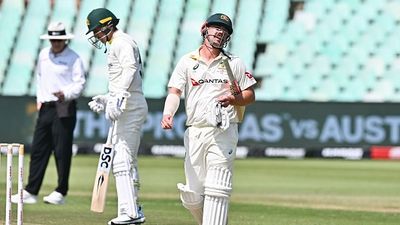
The second Test between South Africa and Australia at St George's Park in Gqeberha is poised for a gripping and dramatic finish on Day 5. At the close of Day 4, Australia found themselves reeling at 156/4, still trailing by 170 runs as they were forced to follow on after getting bundled out for paltry 99 in the first essay. With only a handful of wickets remaining and a hostile Proteas bowling attack smelling blood, explosive left-hander Travis Head stood tall as a beacon of resilience, remaining unbeaten on 87 off 138 balls at stumps. As the match heads into a tense final day, Head represents Australia's absolute last line of defense.
ADVERTISEMENT
South Africa grab winning position on Day 4 of 2nd Test vs Australia
The foundations for South Africa's stranglehold on the match were laid during a monumental batting display earlier in the fixture. Powered by a magnificent 179 off 334 balls from captain Temba Bavuma, alongside crucial, high-impact knocks from Marco Jansen (85) and spinner Simon Harmer (82), the Proteas posted a colossal total of 425/9 declared. Facing a massive deficit of 326 runs, the Australian batting lineup imploded spectacularly against a relentless South African pace and spin battery. Only veteran stalwart Steve Smith offered any meaningful resistance, a knock during which he famously crossed the milestone of 11,000 Test runs. However, lack of support from the other end saw the visitors crumble like a house of cards, bundled out for a paltry 99 in their first innings. Marco Jansen was the chief destroyer with the ball, picking up 5 wickets for 33 runs in a sensational display of seam bowling, backed tightly by Kagiso Rabada and Simon Harmer.
Australia's follow-on and Anrich Nortje’s injury blow
Confronted with a colossal deficit of 326 runs, South Africa skipper Temba Bavuma had no hesitation in enforcing the follow-on. The second innings began with fresh intensity, but the momentum was momentarily disrupted by a major injury concern for the hosts. Ace fast bowler Anrich Nortje, who was breathing fire and consistently clocking speeds around 150 km/h, and had earlier dismissed Marnus Labuschagne, pulled up abruptly during his spell. Exhibiting visible discomfort and clutching his right leg due to a suspected groin issue, Nortje was forced to walk off the field mid-match. Cricket South Africa (CSA) subsequently confirmed that initial assessments showed no severe tearing, but as a precautionary measure, Nortje took no further part in the remainder of the match, dealing a blow to South Africa's pace rotation.
Travis Head’s Lone Crusade on Day 4
Despite Nortje's absence, South Africa's remaining bowlers kept the pressure pinned tightly on the tourists. Plunged back into bat under immense scoreboard pressure, Australia's top and middle order once again wobbled. Marnus Labuschagne (39), Nic Maddinson (8), Beau Webster (8), and Matt Renshaw (11) failed to anchor the innings, leaving the visitors staring at an innings defeat. Enter Travis Head. Walking to the crease with his side's back firmly against the wall, Head played a masterclass of counter-attacking yet disciplined Test match batting.
Unfazed by the hostile crowd or the probing lengths of Rabada, Jansen, and Harmer, Head reached his 21st Test half-century and anchored every partnership of significance during the evening session. Displaying immaculate footwork against the spinners and resolute defense against the pacers, Head hit 9 boundaries in his unbeaten knock of 87. When bad light and fading overs brought an end to Day 4 action, Head was still intact at the crease alongside nightwatchman Scott Boland (2 not out), having steered Australia to 156/4.
As St George's Park prepares for the final day's play, the narrative of the Test match hangs entirely on Travis Head’s shoulders. Trailing by 170 runs with only six wickets in hand, Australia’s hopes of saving the Test, and securing a draw, rest heavily on whether Head can convert his gritty innings into a monumental hundred and find support from the lower order.
How many times AUS have won Test match after being forced to follow-on?
Surprisingly, across more than a century of red-ball dominance, the Australian side has never once managed to claw their way back to victory after being forced to follow on.
Rather than engineering these rare comebacks, Australia has found themselves repeatedly on the wrong end of them. They stand alone in cricket history as the only nation to have suffered defeat on three separate occasions after commanding an opponent to bat again, a fate no other country has experienced more than once.
The rare feat of winning a Test after following on has been achieved just four times globally, and three of those instances featured Australia falling victim to the ultimate turnaround. England famously pulled off the escape twice, overhauling a deficit in Sydney during the 1894–95 Ashes before orchestrating the legendary Headingley heist in 1981. India added their name to the list with their iconic Kolkata comeback in 2001. The only time this script played out without Australia involved was in 2023 at Wellington, where New Zealand edged England by a razor-thin margin of one run.
Here are the three occasions where Australia failed to defend an enforced follow-on:
Sydney (1894): After posting a massive 586, Australia enforced the follow-on, only for England to put up 437. Chasing a modest target of 177, the hosts collapsed for 166, handing England a stunning 10-run victory.
Headingley (1981): Universally remembered as "Botham's Ashes," Ian Botham played a legendary, counter-attacking knock of 149 not out. Bob Willis then tore through the batting order with figures of 8/43, sealing an improbable 18-run triumph.
Eden Gardens (2001): After being asked to bat again, VVS Laxman (281) and Rahul Dravid (180) forged a legendary 376-run partnership. Harbhajan Singh then wrecked the Australian chase in the fourth innings, bowling them out for 212 and snapping their world-record streak of 16 consecutive Test wins.
ADVERTISEMENT