



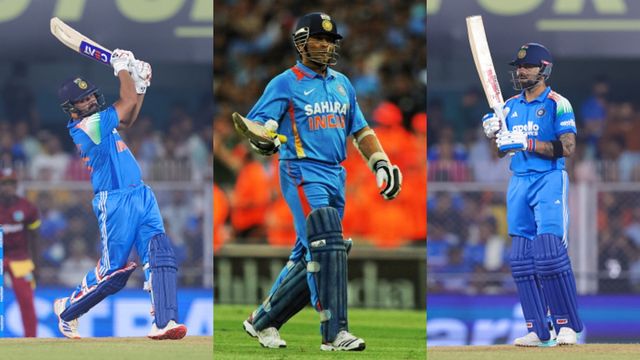
Facing intense scrutiny over their spot in India's 2027 ODI World Cup plans, Rohit Sharma and Virat Kohli answered critics the only way they know how, with back-to-back masterclasses. Match after match, the iconic pair proved that their white-ball supremacy is nowhere near ending. And here's the proof.
Why Rohit Sharma, Virat Kohli’s late-career numbers look just like Sachin’s?
In international cricket, time is usually an undefeated opponent. For the vast majority of elite batters, the mid-to-late thirties bring an inevitable decline in reflexes, hand-eye coordination, and overall physical endurance. Batting averages taper off, strike rates drop, and the aggressive flourish that defined their prime years gives way to a cautious, survivalist approach.
Yet, Indian cricket has witnessed rare, generational anomalies that defy this natural sporting decay. The most famous case remains Sachin Tendulkar, who crafted an astonishing late-career second wind when most expected a graceful fadeout. Fast forward to the present, and history is repeating itself in remarkable fashion. Both RO-KO are treading the exact same blueprint laid down by Tendulkar, redefining longevity as they build toward ODI World Cup 2027.
The Tendulkar precedent
Conventional wisdom dictates that aging batters must sacrifice scoring speed to maintain consistency. When Sachin Tendulkar crossed the age threshold of 35, critics pondered whether his best years were behind him. Instead, the Master Blaster produced one of the most prolific statistical runs in white-ball history.
SACHIN TENDULKAR: CAREER vs POST-35 ODIs
| Metric | Overall Career | Post-35 |
| Batting Average | 44.83 | 49.16 |
| Strike Rate | 86.23 | 92.60 |
Rather than slowing down, Tendulkar evolved. His post-35 phase yielded a higher batting average (49.16 compared to his overall 44.83) alongside an accelerated strike rate (92.60 compared to 86.23). This period was defined by unmatched adaptability, mental sharpness, and a refined intent that eventually culminated in India’s iconic 2011 World Cup title triumph.
Today, Rohit and Virat are executing that exact transformation, reinventing their white-ball game precisely when the sporting world expected them to slow down.
Rohit Sharma's Numbers
Rohit Sharma’s late-career evolution in One-Day Internationals has been nothing short of a paradigm shift. Historically known as a batsman who built his innings methodically before accelerating in the death overs, Rohit turned his template upside down heading into the 2023–2026 cycle.
| Stat Parameter | Career Stats (291 Matches) | 2023–2026 Phase (56 Matches) |
| Total ODI Runs | 12,120 | 2,666 |
| Batting Average | 49.26 | 51.60 |
| Strike Rate | 93.38 | 110.76 |
| Centuries / Fifties | 35 / 63 | 6 / 17 |
| Fours/Sixes | 1,148 / 381 |
285/ 125 |
| Highest Score | 264 |
138
|
As the numbers indicate, Rohit has elevated both his consistency and scoring velocity. Over his entire 291-match career, Rohit averages 49.26 at a strike rate of 93.38. However, across his 56 matches between 2023 and 2026, his average has surged to 51.60, while his strike rate has skyrocketed to an extraordinary 110.76.
By adopting an uncompromising, high-risk approach at the top of the order, Rohit has dismantled opposition bowling in the Powerplay. Hitting 125 sixes in just 56 matches during this period, he has absorbed the risk to set an unshakeable tone for the rest of the batting order—embodying the exact aggressive intent that Tendulkar displayed late in his journey.
Virat Kohli's numbers
If Rohit represents relentless early intent, Virat Kohli continues to define modern batting mastery through pure run-scoring efficiency. Entering his mid-thirties, Kohli has elevated his white-ball numbers to levels that eclipse even his own legendary career baselines.
| Stat Parameter | Career Stats (317 Matches) | 2023–2026 Phase (52 Matches) |
| Total ODI Runs | 15,109 | 2,638 |
| Batting Average | 58.78 | 65.95 |
| Strike Rate | 94.36 | 101.34 |
| Centuries / Fifties | 55 / 79 | 11 / 15 |
| Fours/Sixes | 1,402 / 181 | 230 / 154 |
| Highest Score | 183 | 166* |
Kohli’s overall ODI career statistics, 15,109 runs at an average of 58.78 and 55 centuries—already place him in the pantheon of all-time greats. Yet, his performance from 2023 to 2026 demonstrates an astonishing spike: in 52 matches, he has amassed 2,638 runs at an astounding average of 65.95 and a strike rate of 101.34, piling up 11 centuries and 15 fifties.
Kohli has bridged the gap between old-school anchor duties and modern strike-rotation demands. His surge in six-hitting (154 sixes out of his career total of 181 have come in this recent window alone) underscores a conscious effort to ensure his boundary percentage remains elite without compromising his low-risk run accumulation.
RO-KO's recent form and readiness for World Cup 2027
Any lingering doubts regarding the physical conditioning or hunger of India’s two senior statesmen have been decisively answered by their recent outings on the field.
In recent ODI assignments across late 2025 and 2026, both batters have continued to dominate top-tier opposition. Rohit’s blistering 101-run knock in the second ODI against West Indies showcased that his timing and pull-shot execution remain as sharp as ever. Simultaneously, Kohli’s match-winning consistency in run chases, punctuated by his unbeaten 139 in the ODI series opener against Caribbeans, proves his appetite for big games remains unsated.
With the ODI World Cup 2027 scheduled to take place in South Africa, Zimbabwe, and Namibia, India’s team management faces the challenge of managing workload and squad transition. However, the sheer output of Rohit and Kohli makes them indispensably ready:
Adaptability to Conditions: South African tracks demand strong back-foot play against high pace and bounce—a structural strength for both Rohit’s pull shot and Kohli’s short-of-a-length punch.
The complementary nature of Rohit’s explosive starts and Kohli’s control through the middle overs provides India with a proven, pressure-tested core that younger prospects are still striving to replicate.
Big-Match Pedigree: Much like Tendulkar’s presence in 2011, having two battle-hardened veterans who have experienced multiple World Cup campaigns adds irreplaceable tactical calm to high-pressure knockout fixtures.
The Road Ahead
When Tendulkar raised the World Cup trophy in Mumbai in 2011 at the age of 37, it was the culmination of a deliberate effort to refine his game for one final tilt at ultimate glory. As the road leads toward 2027, Rohit and Kohli are walking that exact path. They are not merely occupying roster spots on reputation or past achievements; their recent numbers—averaging over 50 and 65 respectively while striking well above 100, demonstrate that they are currently playing some of the most destructive ODI cricket of their careers.
If this trajectories hold, the 2027 World Cup will not be a ceremonial farewell tour, but rather the grand finale of two masters who refused to let age dictate their narrative.