





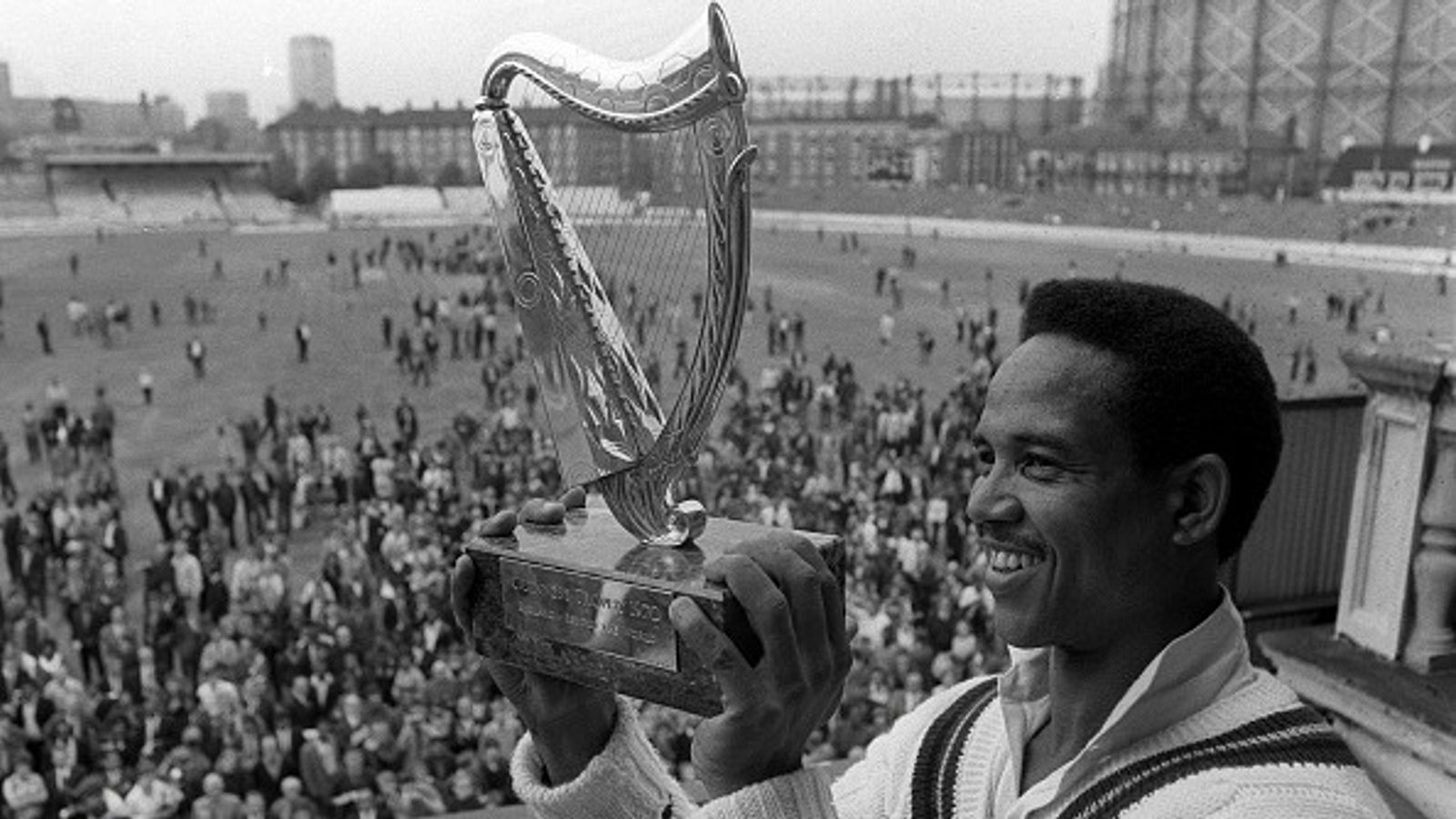
Long before he became a sporting icon, Sir Garry Sobers was born with an anatomical anomaly, an extra finger on each hand. In an incredible display of childhood grit, he removed them himself as a young boy in Barbados using a sharp knife and catgut. This remarkable beginning gave way to one of the most storied careers in sports history, with Sobers eventually evolving into the most complete cricketer the world has ever seen. His multi-dimensional mastery as an explosive left-handed batsman, a versatile bowler who could seamlessly switch between pace and spin, and an electric fielder earned him a spot among Wisden's five greatest cricketers of the 20th century.
In that historic century-spanning list, Sobers finished second only to the legendary Sir Don Bradman. The Australian icon held Sobers in the highest regard, stating unequivocally in 1988 that he was the greatest all-round cricketer he had ever laid eyes on. Despite receiving such celestial praise, Sobers remained deeply grounded. In his later years, he frequently brushed off the "genius" label, insisting that his monumental achievements were the product of relentless hard work and dedication rather than just the raw, natural talent he possessed. The West Indies cricket community announced on Friday that the legendary pioneer has passed away at the age of 89, though no cause of death was provided.
The making of a Caribbean legend
Born in St Michael, Barbados, on July 28, 1936, Garfield St Aubrun Sobers was the fifth of six children born to Shamont and Thelma Sobers. Tragedy struck the family when Garfield was just five years old; his father, a merchant seaman in the Canadian navy, lost his life when his ship was torpedoed by German forces. Left to raise the large family alone, his mother displayed incredible resilience. Sobers warmly recalled in his autobiography that she did whatever was necessary to provide a wonderful upbringing, ensuring all the children went to school well-clothed, well-shod, and well-fed.
Though Sobers was a natural athlete who excelled at basketball and football, cricket quickly became his true calling. His journey began around the age of eight, playing improvised matches on local beaches and streets. These early days were defined by 'Lilliputian cricket', a miniature version of the game played on tiny wickets with makeshift gear. Lacking proper equipment, the neighborhood children carved bats out of fence posts and crafted cricket balls from lumps of tar or rocks wrapped tightly in cloth.
As a young boy from a modest background, Sobers found magic in the radio broadcasts of the West Indies touring India in 1948 and England in 1950. The commentaries inspired him deeply, planting a dream that if he worked hard enough to hone his skills, he too could travel the world representing his country. That dream materialized with astonishing speed. Sobers broke into first-class cricket for Barbados at just 16 years old, made his Test debut for the West Indies by 17, and at age 21, converted his first international century into a monumental 365 not out against Pakistan. To this day, he still holds the historic distinction of being the youngest player ever to score a Test triple-century.
ALSO READ: 'If he retires...': Rohit Sharma's childhood coach's big statement amidst Hitman's retirement talks
A masterclass in team-first greatness
Sir Garry Sobers assumed the West Indies captaincy in 1965 and later signed with Nottinghamshire in the English County Championship. It was during the 1968 season that he carved out a permanent place in cricket folklore by clearing the boundary six consecutive times in one over—a feat never before accomplished in first-class cricket. Facing Glamorgan's Malcolm Nash, Sobers ruthlessly dispatched the first four balls out of the stadium. On the fifth delivery, a fielder successfully caught the ball in the deep but inadvertently stepped onto the boundary rope, prompting the umpire to signal yet another maximum.
With history on the line, the legendary all-rounder effortlessly launched the sixth and final ball over the East Terrace of the Welsh ground. The spectacular sequence triggered a wave of worldwide acclaim, yet Sobers remained remarkably modest about the achievement. He later asserted that looking for individual records is the wrong approach to the game, maintaining that his explosive hitting was solely born out of the team's urgent need for quick runs to win the match.
For Sobers, the team's success always took precedence over individual glory. This balanced approach to the sport is beautifully reflected in his staggering career numbers. By the time he walked away from first-class cricket, he had represented the West Indies, Barbados, Nottinghamshire, and South Australia in 383 matches, accumulating a massive haul of over 28,000 runs alongside more than 1,000 wickets.
ALSO READ: England to release 2 players from ODI squad right ahead of series decider against India at Lord's
A captain caught in a global backlash
The year 1970 marked one of the most turbulent periods of Sir Garry Sobers' career when his decision to play cricket in white-minority-ruled Rhodesia triggered a massive global outcry. The condemnation hit closest to home in the West Indies, where public outrage led to widespread demands for his dismissal as captain. In a formal response to the West Indies Cricket Board, Sobers expressed deep regret, explaining that he had been blind to the intense emotions the issue evoked across the Caribbean. He maintained that he would have never set foot in Rhodesia had he been aware of the political implications.
While he successfully managed to hold onto the captaincy, the ordeal deeply influenced his future choices. According to his memoirs, Sobers went on to decline multiple high-paying invitations to play in apartheid South Africa. His principled stance in the years that followed culminated in a brief but powerful meeting with Nelson Mandela in 1991, just as South Africa's era of segregation was drawing to a close. Mandela left a lasting impression on the all-rounder, who described the statesman as a truly great figure. The meeting also mirrored Sobers' own evolving willingness to confront systemic injustice, as he increasingly began to denounce the heavy racial prejudice that he and other Black players routinely faced on domestic circuits in both Barbados and the United Kingdom.
Immortalised in Barbados history
The immense impact of Sir Garry Sobers’ career reached its pinnacle in 1975 during a massive open-air ceremony in Bridgetown. In front of an estimated 50,000 people, Queen Elizabeth II officially knighted the all-rounder for his legendary contributions to the sport. His homeland further immortalized his name in 1998 by inducting him into the elite group of Barbados' ten official National Heroes. Today, his physical legacy on the island lives on through the Sir Garfield Sobers Sports Complex, a state-of-the-art venue designed to host the country's most prominent sporting and cultural gatherings.
Throughout his lifetime, Sobers routinely pushed back against the supernatural folklore that attached itself to his early years. He was well aware that certain people pointed to his birth with two extra fingers as a mystical sign that he was preordained for a life of greatness. Unbothered by the rumors, the legendary cricketer always maintained a practical outlook, insisting that the extra digits never limited him or shaped the historic athlete he eventually became.