





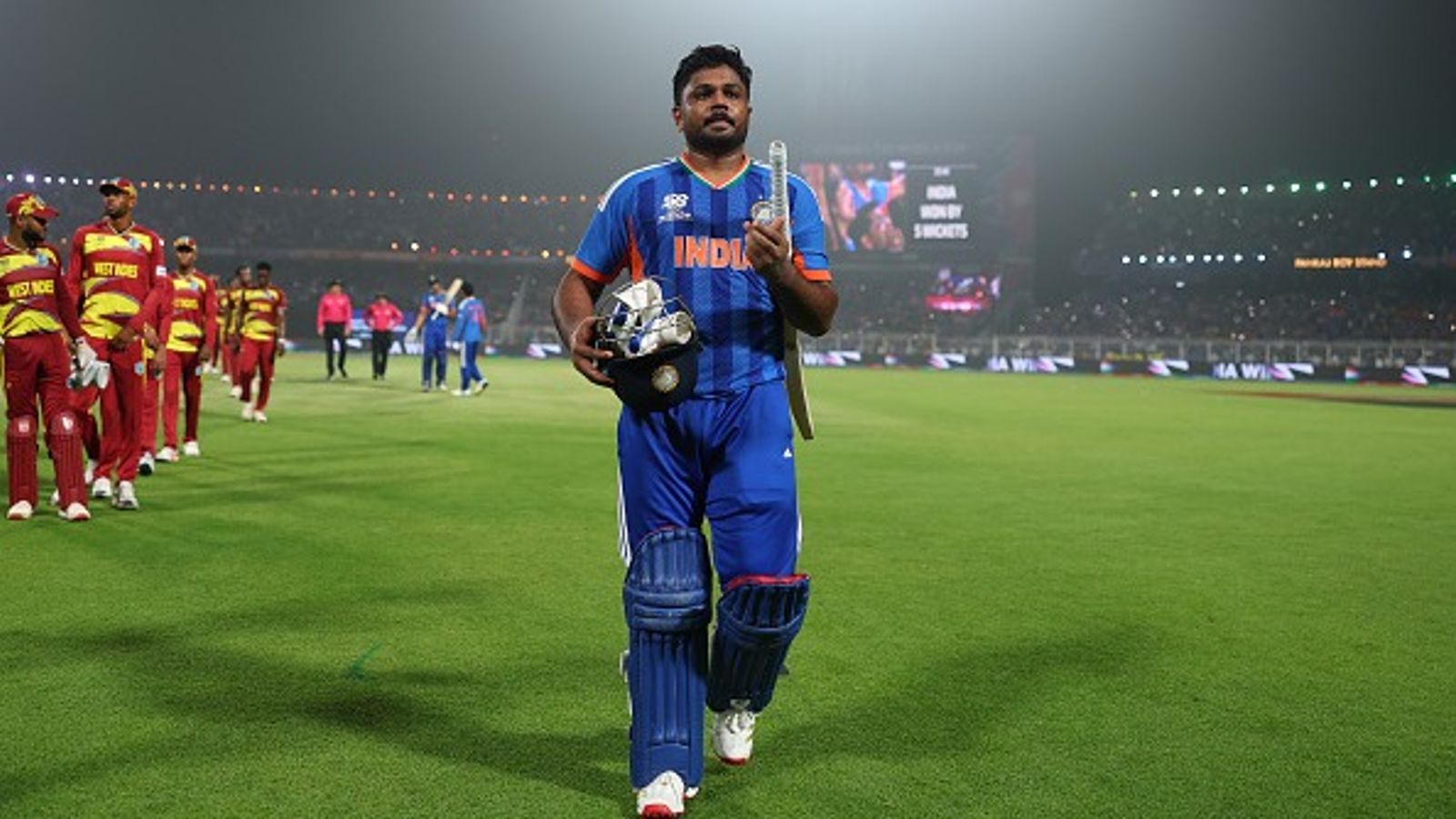
India legend Anil Kumble and former South Africa captain Faf du Plessis have weighed in on Sanju Samson’s heroic rise, and stated that his breakthrough was actually born out of a specific tactical struggle within the Indian camp. They argue that India’s recent vulnerability against off-spin serves as the primary foundation for Samson’s inclusion and subsequent match-winning performance.
India's off-spin struggle, a godsend in disguise for Sanju Samson
Samson’s captivating, unbeaten 97 off just 50 balls has become the talk of the town, especially since he stabilised an innings that appeared to be collapsing. However, this praise for Samson has come at a cost for his teammates, India's left-handed batters are now facing intense scrutiny for their inability to handle off-break bowling effectively.
ALSO READ: 'Dukhi mat ho...': Rohit's powerful message to Samson ahead before T20 World Cup breaks internet
During a rapid-fire segment on ESPNCricinfo, both Kumble and du Plessis were asked if India’s off-spin crisis was ultimately a blessing in disguise. Both experts responded with a definitive 'Yes', pointing to the team's tactical shift. They noted that the struggle of India's left-handed top order, specifically highlighted by Ishan Kishan’s early dismissal against Aiden Markram’s off-spin in the South Africa match, was the exact catalyst that forced the management to bring Samson into the starting XI.
He never looked like he was panicking: Faf Du Plessis
Following their agreement on India's tactical pivot, du Plessis went on to break down the technical brilliance of Samson’s knock. By stepping in when the team was under pressure and nearly carrying them to a century, Samson has not only solved a personnel problem but has also provided the 'best aspect' of India's middle-order stability heading into the knockouts.
"Everything. His control of that inning was an absolute masterclass. And how he chased the total down. He never looked like he was panicking. There was no frustration. He was just timing the ball, reacting accordingly; it was so beautiful to watch someone in control of an inning like that," Du Plessis said.
Faf du Plessis offered a comprehensive breakdown of the match dynamics, starting with the West Indies' tactical approach. He noted that while the Caribbean side would have been pleased to finish the powerplay without losing a wicket, they faltered in the subsequent phase. According to du Plessis, West Indies failed to shift gears after the fielding restrictions were lifted, missing an opportunity to put the Indian bowlers under sustained pressure.
Addressing the criticism surrounding Shai Hope’s uncharacteristically slow innings, du Plessis took a measured stance. While many analysts blamed the skipper’s strike rate for stifling the team's momentum, du Plessis argued against scapegoating a single player. He observed that Hope simply struggled to find the middle of the bat, suggesting that the sluggish scoring was a collective failure rather than the fault of one individual.
However, the former South African captain did suggest that a tactical adjustment might have changed the outcome. He pointed out that the West Indies lacked intensity in the middle overs and proposed that promoting a power-hitter like Shimron Hetmyer earlier in the order could have provided the necessary "force" to elevate their total.
When the conversation shifted to the Indian side, du Plessis provided a candid assessment of Tilak Varma’s performance. He rated Varma’s cameo a 7 out of 10, acknowledging the young batter's contribution but stopping short of calling it a "game-changer." In his view, while the innings was respectable, it wasn't the primary factor that tipped the scales in India’s favor.
The most provocative moment of the analysis came when du Plessis was asked if Shivam Dube’s knack for winning "big moments" is underappreciated. He dismissed the notion entirely, going a step further by mocking the Indian all-rounder's reputation
"I think if he has a big moment, people will celebrate it," Faf said of Dube.
Shivam Dube provided the finishing touch India needed, striking two crucial boundaries in the 19th over to ease the pressure. His brisk cameo of 10 runs from just 4 deliveries, highlighted by those two fours and a hard-run double off a leg-bye, offered vital support to Sanju Samson and ensured India crossed the finish line.