

 Home


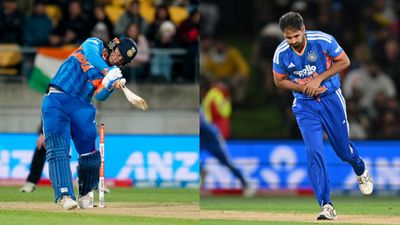
When a team suffers an 87-run thrashing while chasing a mammoth total of 259/7, pointing fingers at individual missing players can often seem like an oversimplification. However, India’s tactical decisions in the fourth T20I at Eden Park in Auckland, specifically the dual exclusion of teenage batting sensation Vaibhav Sooryavanshi and veteran pacer Bhuvneshwar Kumar, lay bare what cost India their unbeaten run in the five-match series.
ADVERTISEMENT
How Sooryavanshi, Bhuvneshwar's absence cost India 4th T20I vs NZ?
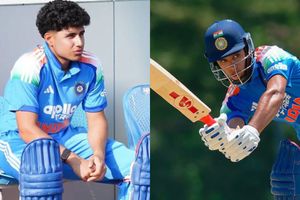
Having already established an unassailable 3–0 series lead, the Indian management made two notable alterations to their playing XI, a fit-again Ishan Kishan replaced Vaibhav Sooryavanshi at the top, while Mayank Yadav was brought into the bowling line-up at the expense of Bhuvneshwar Kumar.
While both players represent opposing ends of the experience spectrum, a granular, statistics-backed analysis reveals that India missed Bhuvneshwar Kumar far more than Vaibhav Sooryavanshi in the fourth T20I. However, Bhuvneshwar Kumar couldn't do much with the ball in the first three matches.
To evaluate who was missed more, one must first look at the sheer scale of the carnage at Eden Park.
Here's Indian bowling's report card:
| Indian Bowler | Overs | Runs | Wickets | Economy |
| Mayank Yadav | 4.0 | 48 | 3 | 12.00 |
| Arshdeep Singh | 4.0 | 38 | 1 | 9.50 |
| Prince Yadav | 4.0 | 49 | 1 | 12.25 |
| Axar Patel | 3.0 | 43 | 1 | 14.33 |
| Nitish Kumar Reddy | 4.0 | 64 | 1 | 16.00 |
| Naman Dhir | 1.0 | 16 | 0 | 16.00 |
Every single Indian bowler conceded runs at over 9.50 an over, with all-rounder Nitish Kumar Reddy leaking 64 runs in his quota.
Case 1: Was Vaibhav Sooryavanshi missed?
Vaibhav Sooryavanshi had been in electric form prior to the fourth T20I. In the third T20I at Wellington, the youngster annihilated the Kiwi attack, scoring 45 off just 19 balls (at a strike rate of 236.84) to set up an explosive opening partnership alongside Abhishek Sharma.
When chasing a colossal target of 260, a team needs an extraordinary start during the Powerplay. Sooryavanshi’s ability to clear the infield with sheer bat speed and capitalize on short straight boundaries at Eden Park could have provided India with the initial momentum required to keep the required run rate manageable.
Despite Sooryavanshi's high-octane intent, his absence was neutralised by the nature of India’s batting performance:
India were reduced to 56/4 in 5.3 overs. Top-order batters like Sanju Samson (4), Ishan Kishan (0), and Abhishek Sharma (27) fell in quick succession to Jacob Duffy and Matthew Fisher. The collapse was caused by poor shot execution across the entire line-up, rather than the absence of one specific opener.
Even if Sooryavanshi had replicated his 45-run blitz, chasing 260 required multiple 70+ run partnerships at a strike rate of 200+. India were eventually restricted to 172/9—meaning they were short by 87 runs. One additional top-order batter could not have bridged an 87-run deficit when six middle and lower-order batters failed to cross the 30-run mark.
Case 2: Why Bhuvneshwar Kumar was the missing link?
The Bowling Catastrophe in the Powerplay & Middle Overs
While batting failures look dramatic on paper, India lost this match in the first innings when they allowed New Zealand to post 259/7—the highest T20I score ever recorded against India. And Shreyas Iyer's post-match remark corroborated this by stating:
"I think we fell a bit short in our bowling to start with. Powerplay, especially in the third over, they got that momentum from there on."
The primary cause for New Zealand's massive score was the complete absence of Powerplay movement and death-overs control.
Failure to Exploit the Early Grass: At the toss, Indian captain Shreyas Iyer explicitly stated, "There's a decent amount of grass, so expecting bounce and seam movement." Despite those conditions, India’s fast bowlers, Mayank Yadav, Prince Yadav, and Nitish Kumar Reddy, relied heavily on raw pace rather than seam control. Express pace without swing on small grounds like Eden Park is a recipe for disaster, as pace simply speeds the ball off the bat over short boundaries.
The Contrast: Bhuvneshwar’s Skillset: Bhuvneshwar Kumar thrives precisely in conditions that offer grass cover and early movement. Excusing his bowling performances in the ongoing series, his career T20I Powerplay economy rate (under 6.80) and ability to extract late aerial swing would have tested Finn Allen and Tim Seifert early on, preventing New Zealand from getting off to a flying start.
The Glenn Phillips & Michael Bracewell Assault: During the middle overs, Glenn Phillips (107 off 49) and Michael Bracewell (65 off 25) added 115 runs, targeting India's inexperienced medium-pacers. Nitish Kumar Reddy (0/64) and Prince Yadav (1/49) were repeatedly punished because they lacked deceptive slower balls and wide-yorker execution. Bhuvneshwar’s vast experience, pace variations, and knuckle-ball accuracy would have provided India with a tactical containment option during the middle and death overs.
Chasing 260 in a T20I imposes psychological pressure that distorts a team's batting strategy from ball one. India’s batters were forced into high-risk shots from the very start simply because the target was out of reach.
Had Bhuvneshwar Kumar played, his early swing bowling and death-over control could realistically have curtailed New Zealand's total by 40 to 50 runs, restricting them to a manageable 200–210. On a small Eden Park surface, chasing 205 is a completely different proposition than chasing 260.
While Vaibhav Sooryavanshi’s exciting top-order power-hitting was missed in the early overs, his inclusion alone could not have overturned an 87-run defeat.
It will be interesting to see whether Indian team management sticks with the current line-up or ends up making some changes for the fifth and last T20I, which is scheduled to be played on November 1 at the Hamilton's Seddon Park.
ADVERTISEMENT