

 Home


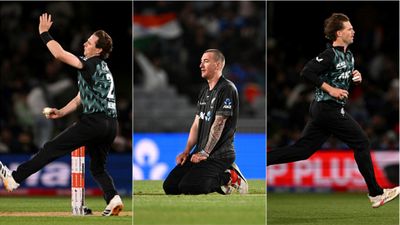
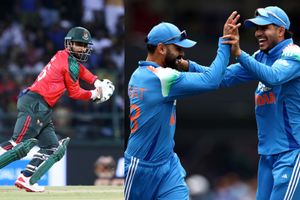
New Zealand's pace attack continues to deal injury blows during the ongoing series against India. Ahead of the third ODI, Blair Tickner, Lockie Ferguson and Matt Henry have been ruled out. On the eve of the third ODI, New Zealand have added Kristian Clarke to the squad as a replacement for Tickner, who was hit by a bouncer resulting in concussion in the second ODI.
ADVERTISEMENT
Initially, Clarke was picked in the squad for the fourth and fifth ODIs. He will join early, as Tickner will serve the ICC's mandatory stand-down period of seven days from the day he suffered a concussion. It rules him out of the third and fourth ODI of the series, which are scheduled to be played on November 10 and 13, respectively. He is likely to be available for the fifth ODI on November 15.
New Zealand's frontline pacer Henry is likely to return for the fourth ODI. He suffered a concussion with opener Devon Conway during a training session in Auckland before the ODI series opener. Henry was initially scheduled to join the Test camp, but he will remain with the ODI squad for the fourth fixture. Similarly, Kyle Jamieson will remain with the squad for the fourth game.
ALSO READ: Hardik Pandya-Arshdeep Singh's blockbuster trade all but sealed ahead of IPL 2027
Lockie Ferguson was expected to join the ODI squad for the fourth and fifth games. Ferguson suffered a low-grade right-calf tear during the second T20I of the series. He has been ruled out of the entire ODI series.
New Zealand Cricket (NZC) on November 9 announced that the selectors will add two more players to the squad for the last two ODIs of the series.
In the batting department, Tom Latham, Daryl Mitchell, Henry Nicholls, Glenn Phillips and Nathan Smith will leave New Zealand's ODI squad to join the red-ball camp ahead of the Test series. New Zealand's Test squad is set to be announced in the next few days.
Trailing in the series 0-2, New Zealand are already missing the services of Conway (concussion), Rachin Ravindra (shoulder injury), and Mark Chapman (hamstring injury). Skipper Santner and head coach Rob Walter will have a hard time choosing the lineup for the upcoming games.
New Zealand's updated squad for 3rd ODI vs India -
Mitchell Santner (c), Michael Bracewell, Kristian Clarke, Jacob Duffy, Matt Fisher, Kyle Jamieson, Nick Kelly, Tom Latham (wk), Daryl Mitchell, Henry Nicholls, Glenn Phillips, Tim Seifert, Nathan Smith, Will Young.
New Zealand's squad for 4th ODI vs India
Mitchell Santner (c), Finn Allen, Michael Bracewell, Kristian Clarke, Jacob Duffy, Matt Fisher, Dean Foxcroft, Mitch Hay (wk), Matt Henry, Kyle Jamieson, Nick Kelly, Tim Seifert (wk), Will Young.
New Zealand’s squad for the fifth ODI is yet to be announced.
Who will take Tickner’s place in the 3rd ODI playing XI?
In the second ODI, Matt Fisher was named Tickner’s concussion replacement. He bowled four overs, conceded 23 runs and bagged the wicket of Axar Patel.
No mammoth scores in ODIs so far
The first two ODIs have been typical New Zealand wickets where the pacers have dictated terms. In the first ODI at Eden Park, Auckland, New Zealand were bowled out for 185 in 40.2 overs. Chasing a revised target of 143, India lost five wickets but Virat Kohli's knock ensured the hosts won with plenty of overs to spare. In the second ODI at Hnry Stadium, Wellington, the Kiwis were bowled out for 134 in 41 overs. Chasing the small target, India lost seven wickets for 113 in 26 overs before rain played spoilsport. India survived a scare, bagging a four-run win via the DLS method.
New Zealand's outgoing batting coach Luke Ronchi is happy to see bowling-friendly tracks in an era of huge totals. He believes a 200-run total would have been huge in Wellington ODI. He expects batters to understand the surface and communicate its nature to the dressing room quickly.
"That's the difficult nature of batting first and understanding, and that's where communication comes into it," Walter said in the pre-match press conference. "The batters that are out there at the moment, you can tell quite quickly if a surface is quicker, if it's slower, if it's moving, and that's the communication those batters pass back to the next guy's batting or if we lose an early wicket then there's communication there, so it's making sure that that's going strongly.
"I think if you stay quiet at that stage, that's where you get yourself into more trouble, so it's a skill in itself."
Kiwi coach wants batters to do the hard thing
Apart from Kohli in the first ODI, Ronchi did not see any batter from either side scoring runs at ease. He feels that Daryl's knock would've been crucial in the second ODI had someone supported him.
"But again, there's not many batters from either side that have really made it look easy, especially the last game. Obviously Virat [Kohli] in that first game did that [he scored 74 in 51 balls], but again it's those moments in games that make a difference, to say, well how can we [approach this],” Ronchi said.
"[Like] Daryl Mitchell [did in Wellington], how can you bat a hundred balls if you got 50-odd or whatever it was [55 in 104 balls], in that moment it's actually a really important innings, and if you can bat around that, but it's a hard thing to. It's a hard thing to trust when you're used to scoring [fast and when] 300's your par, and then all of a sudden you're taking 100 runs off that, it's a big difference," he added.
The story of the third ODI can be similar with pacers dictating terms. On the eve of the third ODI, the practice session was cancelled due to heavy rain at Seddon Park, Hamilton. Once again, the captain winning the toss will look to bowl first as DLS can come into play.
New Zealand will take the field to avoid a series defeat. If India win the third ODI, they will take an unassailable 3-0 lead. It will be India’s first ODI series win on New Zealand soil since February 2019.
ADVERTISEMENT