

 Home
Home

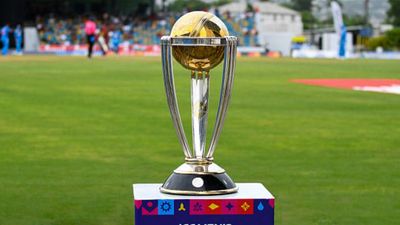
Plans for the next ICC Men’s ODI World Cup took a major step forward following an event in Johannesburg announcing the 12 match venues spread across South Africa, Zimbabwe, and Namibia. Windhoek will represent Namibia alongside three host cities in Zimbabwe and eight across South Africa. This marks the first time since the 2003 edition that the tournament will be held on African soil. Rallying under the theme 'Three Nations, One Heartbeat', the three host countries are collaborating to stage a 14-team tournament focused on community, unity, and regional pride.
ADVERTISEMENT
ALSO READ: History created as India to lock horns with Brazil in international friendly, Know all details here
12 venues for ODI World Cup 2027:
South Africa
Wanderers Stadium (Johannesburg)
Centurion (Tshwane)
Newlands Cricket Ground (Cape Town)
Kingsmead Cricket Ground (Durban)
St George’s Park (Gqeberha)
Mangaung Oval (Bloemfontein)
Boland Park (Paarl)
Buffalo Park (KuGompo City, formerly known as East London)
Zimbabwe
Harare Sports Club (Harare)
Queens Sports Club (Bulawayo)
Fale Mosi-oa-Tunya International Cricket Stadium (Victoria Falls)
Namibia
Namibia Cricket Ground (Windhoek)
ALSO READ: Massive update on Jasprit Bumrah's injury ahead of India's Test series against Sri Lanka
South Africa's hosting resume has expanded dramatically since 2003, having successfully staged the inaugural Men’s T20 World Cup in 2007, both the senior Women’s T20 World Cup and inaugural U19 Women's T20 World Cup in 2023, alongside two U19 Men’s World Cups in 2020 and 2024. While Zimbabwe also shares history as a 2003 co-host, Namibia is preparing for a landmark moment as it prepares to stage its first-ever senior ICC event. Both Zimbabwe and Namibia recently gained hosting momentum after co-hosting the U19 Men’s World Cup earlier this year.
"This marks an exciting milestone on the road to the ICC Men’s Cricket World Cup 2027," ICC Chairman Jay Shah said.
"The unveiling of the host cities and the tournament brand signals the start of a journey that will unite fans around the world and build anticipation for one of our sport’s biggest global events.
“The return of this prestigious tournament to Africa after 24 years is a landmark moment for cricket. We are confident that South Africa, Zimbabwe and Namibia will deliver an unforgettable event, showcasing the warmth, passion and rich diversity that make this region truly unique."
ODI World Cup 2027 will be three-stage tournament
Looking ahead to the 2027 showcase, the tournament is set to deliver a revamping of the competition structure. Spanning 57 matches, the event will introduce a revised three-stage format engineered to elevate match intensity, sharpen team stakes, and create a far more engaging spectating experience from start to finish.
The tournament kicks off with a three-team 'Super Series' wildcard round, where the lowest-seeded nations (ranked 12th through 14th) battle in a round-robin format to claim the single remaining spot in the main draw. From there, the action expands to a 12-team group stage comprising 30 total matches. The field will be split into two groups of six, with every team playing everyone in their pool once.
Crucially, seven teams will survive the opening group phase: the top three finishers from each pool, plus the highest-ranking fourth-place team across both groups. These seven survivors will advance to a 21-match 'Super 7' round-robin league. Once the dust settles in the Super 7, the top four teams will clinch knockout spots, with the league leaders clashing against the fourth-placed side and the second-placed team facing the third-placed squad in the semi-finals.
ADVERTISEMENT