





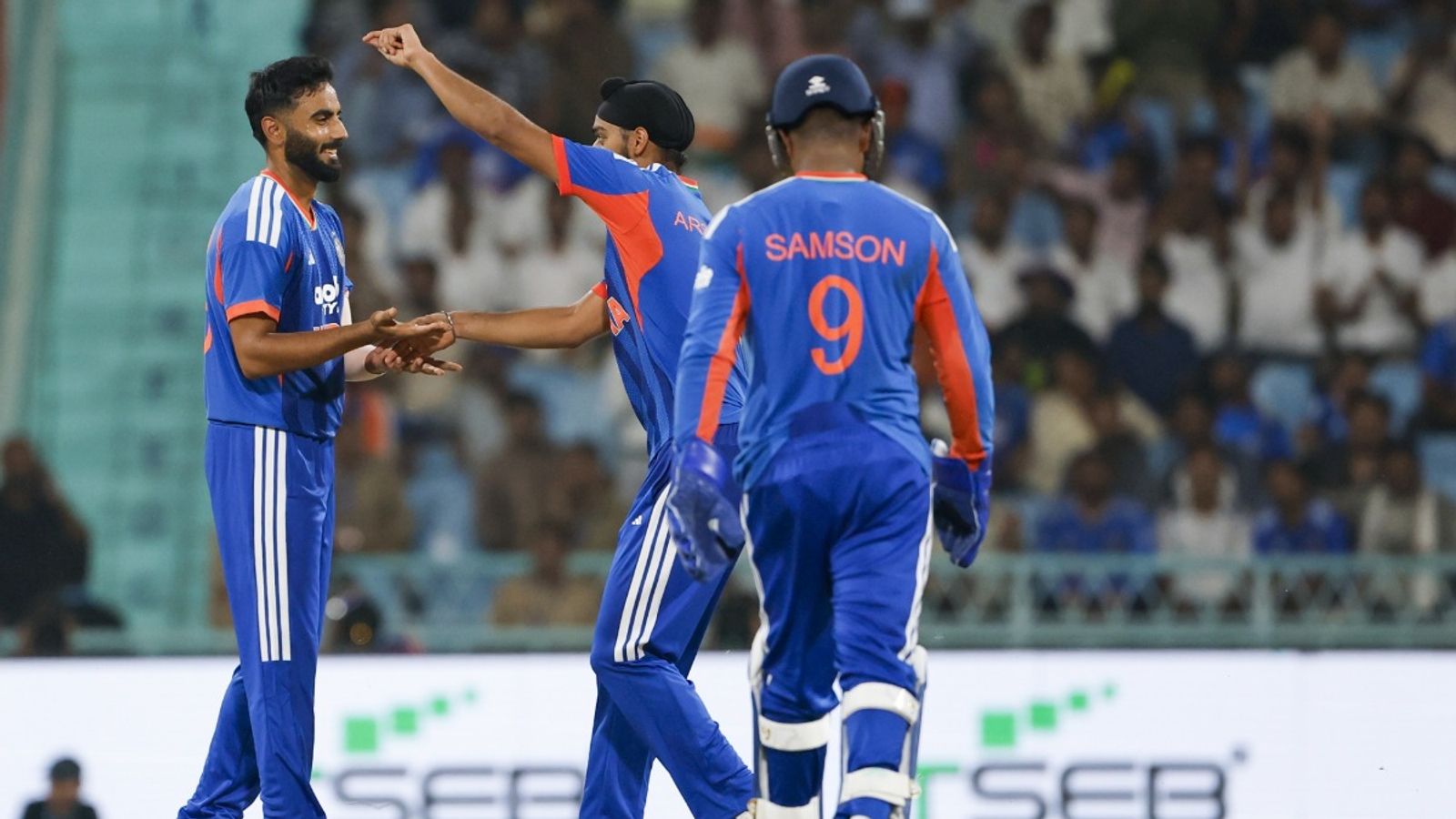
India captain Shreyas Iyer’s maiden T20I century headlined the hosts’ crushing eight-wicket win over West Indies in T20I series opener in Lucknow. But, one of the major positive points was T20I debutant Naman Dhir taking a three-wicket haul and bowling his full quota of four overs. On a spin-friendly track when Dhir was picked, it was expected that he would bowl a couple of overs. Then, depending on how it goes, he will get another over or Iyer will hand the ball to Shivam Dube. But, Dube did not bowl a single over. As India bowled out West Indies for 171, Dhir’s spell stood out and left many wondering what Indian Premier League’s (IPL) controversial ‘impact player’ rule has stolen from Indian cricket or even franchises in last four years.
Dhir was introduced into the attack by Iyer in the 10th over. The off-spinner used the spin and bounce on offer from the surface. Instead of bowling faster trying to make the ball skid, he lured the batter into taking the aerial routes. He went for a six like any other spinner in T20 format but he responded by correcting his length and succeeded in taking three wickets.
The best example was the wicket of a well-settled in-form Shai Hope who was caught at deep mid-wicket by Axar. He bowled in tandem with Kuldeep Yadav. Despite wickets falling, Romario Shepherd saw a weak link in him and tried to attack. Shepherd succeeded and hit a big six. Then, Dhir laid the trap perfectly by bowling it slower and wider outside off. Shepherd saw no threat in going for another big shot. He ended up miscuing it to the long-off fielder. In his last over, Shamar Springer made the mistake as well. This time, it was Dhir's fuller delivery which the batter couldn't get under. Lacking the elevation, it landed in Axar's safe pair of hands again.
Dhir ended up taking three wickets for 31 runs. He became the third Indian spinner to take a three-fer or more on T20I debut joining the likes of Axar and current men's selection committee's interim head, Pragyan Ojha.
"Obviously the first wicket which I got today was an achievement for me, but at the same time it is all about executing your plans. The wicket demanded that I bowl a bit slower, which, at the end of the day, bore fruit," Dhir said after India’s commanding win in series opener.
"I have been bowling for quite a long time, it's not that I have started now. In IPL, you see me bowling less because of the impact player rule, but it's not that I am not being bowling, and in future I will continue to perform well with the ball."
"I saw Axar (Patel) bhai bowling at a slower pace and it was turning, and then I thought if I bowl a bit slow, I will get grip from the wicket and get some wickets. So I stuck to my plans and I guess the result came out."
ALSO READ: Delhi Capitals sack Badani, rope in ex-India captain as new head coach to end IPL title drought
Is impact player a boon or bane for IPL?
The ‘impact player’ is often debated. Captains, players, coaches have not shied away from criticising it. The rule has led to long batting lineups destroying bowling attacks in batting-friendly conditions. The economy rate of bowlers have seen an upwards trend. Even someone conceding at nine runs per over is not considered bad in an IPL match anymore. In last few years, there have been plenty of 250-plus scores.
However, it is not just the batting that has benefitted. Franchises who have used the ‘impact player’ rule wisely sub out a batter and introduce a specialist bowler. In doing so, it has robbed the all-rounders a chance to showcase their skill. Yes, a specialist bowler is what a captain wants but it has often led to batters with bowling skills missing out on getting the experience of bowling to big-hitters under pressure.
The Dube case study
Plenty of all-rounders have criticised the ‘impact player’ rule for limiting their role in an IPL franchise. One of the most notable examples in the current team is Chennai Super Kings’ (CSK) Dube. In the gold medal match against Pakistan, he broke the partnership after Ravi Bishnoi had a bad day and conceded 44 runs from three overs. In the T20 Asia Cup 2025 final against Pakistan, he filled in for an injured Hardik Pandya and conceded 23 runs from three overs. To put things in perspective, Jasprit Bumrah conceded 25 runs from 3.1 overs. Dube did not take two wickets like Bumrah but he did not leak too many runs either.
The 33-year-old has 40 wickets from 52 T20I innings where he has got a chance to bowl. He bowled just 30 balls in IPL 2026. In total, he has bowled 25.4 overs in his IPL career and taken six wickets. There is a stark difference and it is unlikely to be bridged as long as the ‘impact player’ rule is in existence.
Space for genuine all-rounders, limited opportunities for others
Genuine all-rounders like the Pandya brothers, Jamie Overton, Mitchell Santner, Corbin Bosch, Marco Jansen and others still enjoy a bigger role in their respective franchises. But, it is the batters who can bowl or the bowlers who can play a good hand when the team is in trouble who have faced the brunt of the ‘impact player’ rule. For example, the IPL has turned a genuine spin-bowling all-rounder Rahul Tewatia into a finisher. Tewatia hasn’t bowled a single over for Gujarat Titans (GT) in last three IPL seasons. Since he has joined GT, he is yet to take a wicket. His last IPL wicket was in Rajasthan Royals (RR) jersey five years ago.
India head coach Gautam Gambhir has often focused on batters being able to contribute with a few overs. A decade or two ago, India had batters like Sourav Ganguly, Sachin Tendulkar, Virender Sehwag, Suresh Raina who could contribute with overs and even provide breakthroughs if called upon. In today’s world, their numbers would also qualify as close to a full-fledged all-rounder.
But again, how often have you seen Abhishek Sharma, Tilak Varma, Vaibhav Sooryavanshi, Yashasvi Jaiswal bowl in the IPL? Here is the answer: Sooryavanshi is yet to bowl a single bowl in two IPL seasons. He was often subbed out. Sunrisers Hyderabad’s (SRH) Abhishek bowled a total of 29 balls in IPL 2026. The left-arm spinner has 12 wickets in T20Is including a three-fer against Zimbabwe and two wickets for just two runs against Sri Lanka in recent Asian Games 2026 semifinal. Varma hasn't bowled a single over for Mumbai Indians (MI) in last two seasons despite their bowling troubles. He has bowled just 22 balls in 68 IPL games. The last time Jaiswal bowled in IPL was in 2022.
In addition, players like Venkatesh Iyer, Ashutosh Sharma, Ramandeep Singh, Rinku Singh and others don’t get to bowl for their franchises. Notably, many didn’t know Ashutosh’s bowling prowess in white-ball cricket until he made a name for himself taking 14 wickets for Hampshire in England’s domestic One-Day Cup. Ashutosh is seen as a beneficiary of the impact rule but whey isn’t his medium pace being utilised or tried by DC? It also gives rise to another question. IPL franchises don't have a dearth of coaching staff from around the world. But, will players like Ashutosh get more time bowling in the nets to fine-tune their skills under these coaches if the franchise don't intend to use their bowling services in the game? After all, they have a limited amount between games and would want to focus on their specialist bowlers to deliver the goods.
The list of all-rounders gets longer but the question remains the same. Is the ‘impact player’ rule here to stay in the name of entertainment. Yes, India have ton two consecutive T20 World Cup titles. But, they won’t always have the services of Hardik and Axar. They need others to step up but others need a stage to showcase talent too but the controversial rule may have robbed them of a chance.