

 Home
Home

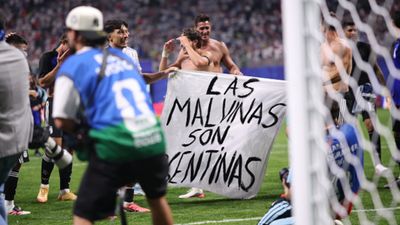
Argentina's dramatic FIFA World Cup 2026 semi-final victory over England has been overshadowed by a political controversy that could land the defending champions in disciplinary trouble. Following the 2-1 comeback win, several Argentina players were seen holding a banner reading "Las Malvinas son Argentinas" ("The Falkland Islands are Argentine"), prompting calls from the UK government for FIFA to investigate the incident.
ADVERTISEMENT
While FIFA has confirmed that its independent Disciplinary Committee is assessing the matter, Argentina could still have a potential defence that may help them avoid severe punishment.
Also Read: REVEALED: Why did Lamine Yamal train separately before Spain vs Argentina FIFA World Cup final
Fan involvement could prove crucial in Argentina's defence
One of the biggest mitigating factors in Argentina's favour is the claim that the controversial banner was not brought onto the pitch by players or team officials, but was instead thrown from the stands by supporters after the final whistle.
Full-back Gonzalo Montiel insisted that the players simply picked up the flag after it landed on the field, while Argentine journalist Nelson Castro also stated that a supporter had thrown the banner onto the pitch before it reached the squad.
If FIFA accepts that the banner originated from spectators rather than the Argentina camp, it could significantly influence any disciplinary outcome. The governing body would still need to determine whether merely displaying the banner constitutes a breach of its regulations, but the source of the flag could be viewed as an important mitigating circumstance.
What FIFA rules say and why Argentina remain at risk
Despite that possible loophole, Argentina are not entirely out of danger. Article 34.3 of the FIFA World Cup Regulations clearly prohibits players and officials from displaying political, religious or personal messages before, during or after matches, regardless of the language or format used.
FIFA has already confirmed that its independent Disciplinary Committee is reviewing the match reports before deciding whether disciplinary proceedings are warranted.
Argentina also have previous history in similar circumstances. In 2014, FIFA fined the national team after players displayed a banner carrying the same "Las Malvinas son Argentinas" message before an international friendly against Slovenia, ruling that it breached the governing body's regulations regarding political messages and team misconduct.
Also Read: All the records Lionel Messi has broken across his historic six FIFA World Cup campaigns
The latest incident came after Argentina's victory over England booked their place in the FIFA World Cup 2026 final against Spain. While Downing Street has urged FIFA to investigate the matter, the governing body has yet to determine whether the players' actions warrant sanctions or whether the supporters' involvement will be treated as sufficient mitigation.
For now, Argentina's hopes of avoiding punishment may largely depend on whether FIFA concludes that the players intentionally used the banner for a political statement or simply reacted to an item thrown onto the pitch by supporters.
ADVERTISEMENT